
English speaking
How to Start a Conversation in English — and Keep It Going

There is a specific kind of paralysis that has nothing to do with your level. A colleague from another office is standing next to you at the coffee machine. Someone sits down beside you on a long flight. A language partner connects and the video opens. You know the grammar. You know the words. And your head is completely empty, because you do not have a first sentence — so you wait for them to speak first, and the moment passes.
Here is the thing almost nobody tells learners: fluent speakers are not inventing those first sentences either. Openers are among the most formulaic parts of any language, recycled from a small set of patterns that everyone already knows. This guide covers how to start a conversation in English — three openers that reliably work, the questions that stop a conversation dying after three minutes, how to survive a silence, and how to end it cleanly. There are fewer than twenty sentences to learn in total.
Openers are memorised, not invented
The mistake behind most frozen moments is treating the opening line as a creative problem. It is not. Listen to native speakers starting conversations and you will hear the same handful of moves all day: a comment about the weather, a remark about the queue, a question about how someone knows the host. Nobody is impressed by the sentence itself, and nobody is judging it — its only job is to signal that you are open to talking.
This matters because it changes what you have to prepare. You are not building the ability to improvise under pressure. You are stocking a very small shelf. Once the first line is out, the conversation supplies its own material, and the pressure drops immediately.
Three principles run through everything below.
- Leave them something to answer. An opener that can be closed with one word has failed at its job. This single principle explains most of the specific advice further down.
- Low stakes beat clever. Pretty cold today, isn’t it? works precisely because it asks nothing of anyone. Trying to open with something memorable raises the cost of the exchange for both of you.
- The quality is decided in the next five sentences, not the first one. People worry almost exclusively about the opener and almost never about what comes after it, which is exactly backwards.
One more reassurance, because it removes a surprising amount of fear: in English-speaking cultures, small talk is not considered shallow or a waste of time. It is the expected on-ramp to any real conversation, and skipping it reads as abrupt. You are not being asked to be interesting. You are being asked to be available.
Three ways to open a conversation
Nearly every English conversation starts in one of three ways. Pick whichever fits the room and stop looking for a fourth.
1. Comment on the situation. Mention whatever you are both currently experiencing. It is the safest option and by far the most common — the weather, the queue, the venue, the event.
- Pretty cold today, isn’t it?
- This line is taking forever.
- Have you been to one of these before?
- The coffee here is actually really good.
2. Ask about them. More direct, and it gets to a real conversation much faster.
- So how do you know Sarah? (at a party or gathering)
- Are you from around here?
- What do you do? — the standard way to ask about someone’s job. What is your job? is grammatically fine but sounds like a form.
- How long have you been working here?
3. Give a compliment. In English, a compliment is a recognised tool for opening a conversation, used far more casually than in many other cultures.
- I like your bag — where did you get it?
- That jacket is great.
Notice the addition on the first one. A bare compliment forces the other person into a dead end: they say Thanks, and now you both need a new sentence. Attaching a question — where did you get it? — turns the compliment into an opening. Do this every time.
Two small traps worth knowing. Nice to meet you is only for a genuine first meeting; from the second time onward it is Good to see you, and using the first one again quietly signals you have forgotten them. And How are you? is closer to a greeting than a question — the expected answer is short. Good, thanks — you? and then move on. A detailed account of your week in response is a common and very visible non-native move.
Questions are what keep it moving
The difference between a conversation that dies in three minutes and one that runs for thirty is almost never vocabulary. It is the kind of question being asked.
Avoid closed questions. Do you like the city? can be answered with Yes, and then the silence is your problem again. What do you like about the city? cannot be. Same information, completely different outcome, because the second one makes a sentence the only possible reply.
- Do you like your job? → What’s the best part of your job?
- Was it good? → What did you think of it?
- Do you travel a lot? → Where was the last place you travelled to?
Follow-up questions are the real skill. Most conversations stall not from a shortage of questions but from a shortage of questions that grow out of the last answer. When someone says something, grab one word from it and ask about that.
- They say: I just got back from Vietnam. → Oh nice, what took you there? / How long were you there for? / What was the food like?
- They say: I work in marketing. → What kind of marketing? / How did you get into that?
Four all-purpose follow-ups cover almost any answer anyone will ever give you: What was that like? / How did that go? / What made you decide that? / Really? Tell me more about that. Learn these four and you will never again be left holding a finished answer with nothing to do.
Then hand it back. When you are asked something, answer and return it: What about you? or How about yourself? This tiny phrase is what separates a conversation from an interview. Ask without returning and it becomes an interrogation; answer without returning and it becomes a monologue.

Keeping the ball in the air
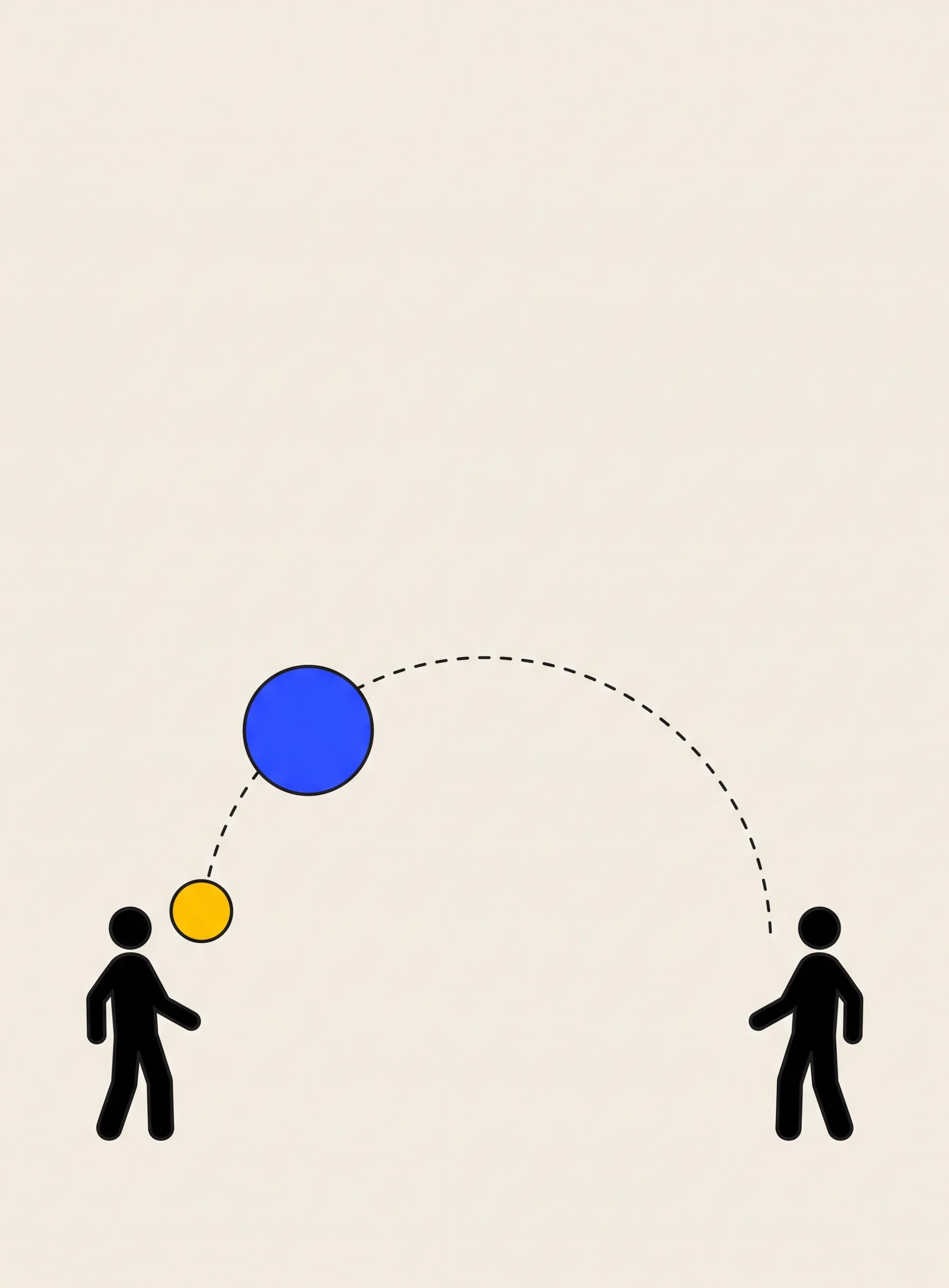
The governing image for English conversation is a ball being passed back and forth. If it arrives, you have to send it back — and the tolerance for holding it is short.
There are three ways to return it.
- React. A short reaction alone is a valid return. Oh really? / That makes sense. / No way. / That sounds tough. / I can imagine. Learners underuse these badly, because in many cultures attentive silence signals respect. In English it reads as boredom, and speakers will start winding down.
- Add your own. Oh, same here — I did that last year too. / That reminds me of… Laying your experience alongside theirs widens the conversation instead of just advancing it.
- Ask again. The follow-up question from the previous section.
Good conversations alternate between all three. Only reacting is flat; only adding your own takes over the floor; only asking turns it into an interview.
When a silence arrives, have an exit ready. An awkward pause is an ordinary part of conversation, not a failure, and a prepared phrase covers it entirely: Anyway… is the simplest possible signal that the topic is changing. So are So, changing the subject a bit…, Oh, that reminds me — and By the way, did you hear about…?
When a word goes missing, do not stop — describe your way around it. It’s like a… you know, the thing you use to… Native speakers do this several times an hour and nobody registers it as a failure. And when you have not understood them, a specific question works much better than a bare Sorry?: Sorry, what does “X” mean? or Could you say that again a bit slower? Specific requests get you a useful answer; Sorry? usually just gets you the same sentence at the same speed.
Knowing how to end one makes it easier to start one
This connection is not obvious, but it is real. A great deal of the reluctance to start a conversation is actually a fear of being trapped in it — if you do not know how to leave, every opening line carries an unknown cost. Closings are as formulaic as openings, so learning them buys back the confidence to begin.
An English conversation closes in three beats: reason, warm line, future reference.
- Reason: Anyway, I should get going. / I’ve got to run, actually. / I won’t keep you.
- Warm line: It was really nice talking to you. / Great chatting with you.
- Future reference: See you around. / Let’s catch up soon. / Hope to see you again.
Strung together: Anyway, I should get going — it was really nice talking to you. See you around! Memorise that as one block and you can close any conversation cleanly, which means you can open any conversation without anxiety.
One cultural note that saves confusion. Let’s catch up soon and We should grab coffee sometime are usually closings, not plans. They are warm noises that end the exchange politely, and no one is expecting a calendar invitation. If you genuinely want to meet, you have to be concrete: Are you free next week? Learners regularly feel let down by a coffee that never happens, when nothing was ever actually proposed.
It is also worth knowing that ending a conversation is not rude in English-speaking settings — keeping someone longer than they intended is the bigger imposition. The existence of the phrase I won’t keep you, which frames leaving as a courtesy to the other person, tells you everything about that norm.
How to practise this
Everything above is raw material, and there is a large gap between knowing an opener and having it arrive on time. Three steps close that gap.
- Memorise eight sentences. Three openers, four follow-up questions, one closing block. That is the entire skeleton of a conversation, and eight is a small enough number to actually finish.
- Run it alone. Pick a situation — a coffee queue, a lift at work, an online meetup — and talk yourself through it out loud from the opener to the closing, inventing the other person’s replies as you go. Two minutes a day. This feels silly and works anyway, because it puts the sentences through your mouth instead of your eyes.
- Isolate one thing per real conversation. Today, follow-up questions. Next time, reactions. After that, the closing. One at a time, never all of them — monitoring everything at once produces silence.
Step three needs another person, which is the part most learners cannot easily arrange. Memorising openers is useless if there is never anyone to open with. CoffeeTalk connects you with native speakers for short conversations and lets you pick a topic beforehand, which makes it easy to test one element at a time in a real exchange. Fifteen minutes is enough to run the whole arc from first sentence to closing once.
Finally, and most usefully: the first sentence does not need to be good. Native speakers open with Pretty cold today and think nothing of it. The quality of a conversation is decided by the five sentences after the opener, and those five are made almost entirely of the reactions and follow-up questions above — all of which you can prepare in advance.
If you want more ground underneath this, English greetings covers what to say in specific situations, short English dialogues gives you whole exchanges to absorb, and if the underlying problem is that speech itself comes out slowly, how to improve English speaking deals with that directly.

FAQ
How do I start a conversation in English with a stranger?
Use one of three openers: comment on the shared situation (Pretty cold today, isn't it?), ask about them (So how do you know Sarah? / What do you do?), or give a compliment with a question attached (I like your bag — where did you get it?). The only rule that matters is leaving them something to answer, which is why a bare compliment without a question tends to stall.
What do I say when the conversation goes quiet?
Have a topic-change phrase ready and use it without apology. Anyway… is the simplest signal that you are moving on, and So, changing the subject a bit… , Oh, that reminds me — and By the way, did you hear about…? all do the same job. An awkward pause is an ordinary part of conversation rather than a failure, and nobody remembers it once the next topic starts.
Why do my English conversations die after a few minutes?
Usually because the questions can be answered in one word. Swap Do you like the city? for What do you like about the city?, then build your next question out of their answer instead of starting a new subject. Four follow-ups cover nearly everything: What was that like? / How did that go? / What made you decide that? / Really? Tell me more about that.
Is small talk really necessary in English?
Yes, and it is not considered shallow. In English-speaking cultures small talk is the expected on-ramp to a real conversation, and going straight to the substance can read as abrupt. Weather, travel, the venue and the queue are all doing social work rather than exchanging information, so the content genuinely does not need to be interesting.
How do I end a conversation in English politely?
Use three beats: a reason, a warm line and a future reference. Anyway, I should get going — it was really nice talking to you. See you around! Memorise it as one block. Note that Let's catch up soon and We should grab coffee sometime are usually polite closings rather than actual plans; if you really want to meet, say something concrete like Are you free next week?