
English phrases
English Greetings: What People Actually Say Instead of the Textbook Version

The first thing to collapse in a real English conversation is, oddly, the very beginning. Your vocabulary is fine and your grammar is better than you think, but you make eye contact with a colleague in the lift and freeze — because the only thing loaded in memory is the I’m fine, thank you. And you? you learned at fourteen, and some part of you already suspects nobody says that.
They don’t. The problem is not that English greetings are hard; it is that most courses teach one long sentence where English actually uses a handful of very short, very fixed ones. Many languages get by with a single all-purpose greeting that works morning or night, boss or friend, arriving or leaving. English splits that one slot across time of day, how close you are, and whether you are coming or going. This guide fills in those slots one at a time. There is less to memorise than you expect.
Why the textbook greeting fails
I’m fine, thank you. And you? is not wrong. It is grammatical, it is comprehensible, and it will never confuse anyone. The trouble is that it sounds like a recording. Native speakers clock it instantly as something learned from a book rather than from a person.
Three things are doing that. First, it is too long. Real greetings run two or three words. Good, you? is the whole exchange. Second, fine is a slippery word. I’m fine. said flatly often means the opposite of fine — it is what people say when they are upset and do not want to discuss it. Third, And you? is stiff where You? or How about you? is natural.
But the deeper issue is structural. In a lot of languages, greetings carry content. Mandarin has 你吃了吗 and Korean has 식사하셨어요 — ‘have you eaten?’ — questions that long ago stopped being questions and became hello. English greetings went the other way: they are deliberately empty, and filling them with real information is what makes an exchange go strange. Understanding that one difference solves about half the problem before you learn a single new phrase.
So this guide does not list fifty expressions. The goal is two or three per situation, fully automatic. Greeting someone is a moment with no thinking time in it, so what matters is not how many options you know but how fast one arrives.
Arriving: Hey, Hi, Hello, Good morning
English hellos line up neatly on a scale of closeness. Learn the order and most of your decisions are made for you.
- Hey — the most casual. Friends, colleagues you know, anyone you have already met. In most English-speaking workplaces today this is effectively the default. Skip it with strangers and in formal settings.
- Hi — the safe middle. It works with a stranger, a manager and a friend alike. If you only ever learn one, learn this one.
- Hello — a notch more formal and a notch more distant than Hi. Natural when answering the phone or approaching someone you do not know. Said slowly and crisply to a friend, it sounds either sarcastic or annoyed.
- Good morning / Good afternoon / Good evening — formal situations, customer-facing work, the opening of a presentation. In offices it mostly survives in the morning, and usually clipped to Morning!
- What’s up? / How’s it going? / Sup? — friends and close colleagues. These look like questions and are not; the next section deals with them.
Two traps worth flagging now, because both are extremely common among learners.
Good night is a goodbye, not a hello. The evening greeting is Good evening. Good night is only for leaving or going to bed. Arriving at a dinner party and announcing Good night! tells everyone you are already on your way out.
Good day is not used. It turns up in older textbooks and it is essentially dead in modern English — outside Australian G’day, it sounds either archaic or faintly hostile, which is the opposite of what you meant.
‘How are you?’ is not a question
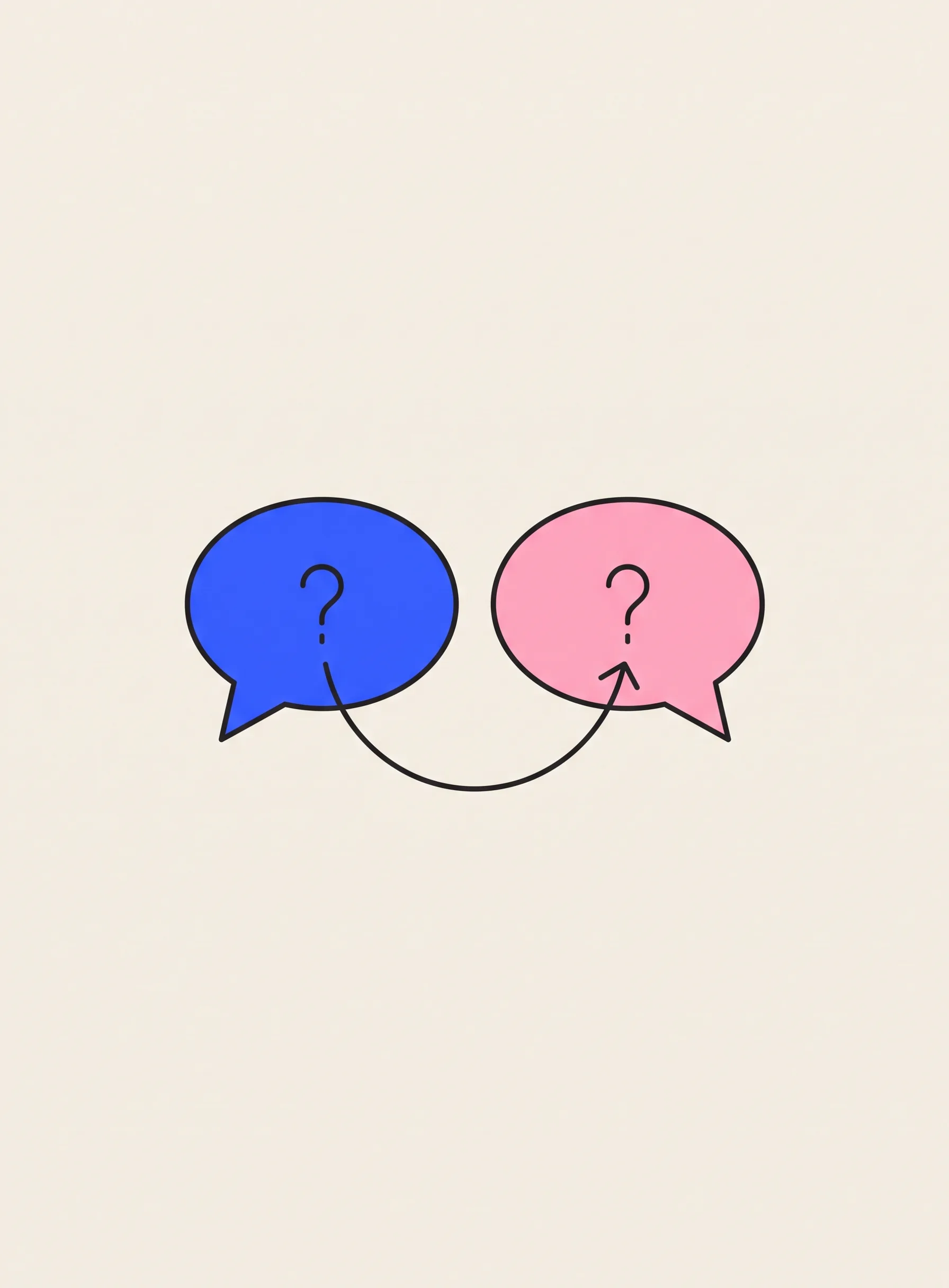
If you take one thing from this article, take this. In English, How are you? is part of the greeting, not an enquiry into your wellbeing. It is closer to a handshake than to a question, and treating it as a genuine request for information is the single most recognisable learner move there is.
The shape is almost fixed. A greets and asks, B answers briefly and asks back, A answers briefly. Then it ends, and the real conversation starts afterwards.
- How are you? → Good, thanks. You? / Pretty good. How about you? / Not bad.
- How are you doing? / How’s it going? → identical. Good, you? covers all of them.
- What’s up? / What’s going on? → this is the trap. The answer is not Good but Not much. / Nothing much, you? / or simply Hey! The question is literally asking what is happening, so the answer reports that nothing is.
- How’s everything? / How have you been? → Good! Busy, but good. These show up after a longer gap and sit slightly closer to being real questions.
The three mistakes learners reliably make:
Answering honestly and at length. When a cashier says How are you today?, that is not an invitation to describe your week. Good, thanks. You? and you are done.
Saying ‘So-so.’ It exists in dictionaries and native speakers almost never use it; when they hear it they read it as a complaint. If you genuinely feel middling, Not bad. or I’m okay. does the job without derailing anything.
Forgetting to ask back. This one is bigger than it looks. Stopping at Good. leaves the exchange hanging and puts all the work back on the other person. You? is one syllable and it keeps the conversation alive.
Meeting for the first time, and after a long gap
English splits ‘pleased to see you’ according to whether you have met before, and getting it wrong is startlingly common.
First time: meet. Nice to meet you. / Good to meet you. / for someone you have heard about for ages, Nice to finally meet you. Adding the name lifts it noticeably — Nice to meet you, Daniel.
Already acquainted: see. Good to see you. / Nice to see you again. Saying Nice to meet you to someone you already know reads as have we met?, and you will watch them hesitate while they work out whether you have forgotten them. Meet is first, see is again — that single line covers it.
After a long gap: It’s been a while! / It’s been ages! / Long time no see! That last one is genuinely used but carries a jokey, informal tone; with a client you have not seen in two years, It’s good to see you again is the safer choice.
There is also a category of greeting to avoid importing. In several languages, ‘have you eaten?’ and ‘where are you going?’ are ordinary hellos. In English they are literal questions. Did you eat? will be taken as either concern or an offer of lunch, and Where are you going? sounds like you are checking up on someone. Neither one lands as friendly.
One physical note, since greeting is not only words. English-speaking cultures expect eye contact during a greeting. A handshake in formal settings, a small wave or a nod in casual ones, and in both cases you look at the person. In cultures where lowering the gaze is polite, this takes conscious effort — but averted eyes get read as evasiveness or lack of confidence rather than as respect, so it is worth the effort.
The first line of an email or a message
Written greetings are easier, because the rules are clearer. What causes trouble is importing the letter-writing etiquette of your own language wholesale.
The default opening is Hi [name], and it covers a startling range of situations — a first approach to a new client, a note to your manager, a message to someone three levels up. If you want a touch more formality, Hello [name],.
- Dear Mr. Kim, — genuinely formal contexts only: job applications, complaints, legal correspondence. On a routine work email it creates distance you probably did not intend.
- Dear Sarah, — Dear plus a first name and no surname reads as either old-fashioned or oddly intimate in most workplaces. Hi Sarah, is what you want.
- To whom it may concern, — only when you truly cannot find a name. Spend two minutes looking for one first; it is almost always findable and it always helps.
- Writing to several people — Hi all, / Hi team, / Hello everyone,.
- The pleasantry line — I hope you’re doing well. / Hope you had a good weekend. I hope this email finds you well still circulates but is now a well-worn cliché.
Chat is a different medium entirely. A habit worth unlearning: sending Hi Sarah on Slack or Teams and then waiting for a reply before saying what you want. In English-speaking workplaces this is mildly irritating, because the other person is now on the hook with no idea what for. The convention is to put the greeting and the point in the same message.
Hey Sarah — quick question about the deck. Do you have the latest version?
One line. Far from being abrupt, this reads as considerate: you have saved the other person a round trip. If the message is a first introduction rather than a quick question, how to introduce yourself in English covers what comes next.
Leaving: the other half of greeting
Many languages manage goodbyes with one phrase. English spreads them out, and learners typically know only Bye, which ends conversations with an audible thud.
- Bye. / Bye-bye. — the baseline. Bye-bye carries a faint whiff of talking to a child.
- See you. / See you later. / See ya. — the most common of all, and used freely even when you have no plans to see the person again.
- Take care. — warm and safe, especially for someone you will not see for a while.
- Have a good one. / Have a good day. / Have a good weekend. — you will hear this ten times a day in shops and offices. The reply is You too!
- Talk to you later. / Talk soon. — for ending a call or a chat thread.
- It was nice meeting you. — for someone you met today. Note the shift: Nice to meet you on arrival, Nice meeting you on departure. The tense moves because the meeting is now behind you.
- Goodbye. — surprisingly rare. Said in full it sounds formal, or final, as though you do not expect to meet again.
English goodbyes also usually come with a line that announces the exit before the farewell itself. Dropping a bare Bye into a conversation feels like hanging up mid-sentence.
Anyway, I should get going. / I’d better run. / I’ll let you go. Then the farewell: It was really good seeing you. Take care! Those two moves together are the difference between ending a conversation and abandoning one.
How to get these into your mouth
Greeting someone is a moment with no thinking time, which means it needs a different study method from the rest of your English. Knowing many options is useless here. One option arriving instantly is everything.
- Choose exactly one phrase per situation. Arriving: Hey, how’s it going? Answering: Good, thanks. You? Leaving: Take care! Three phrases cover perhaps ninety per cent of your daily need. Narrowing the choice is the whole technique.
- Say them aloud twenty times. Reading and speaking use different machinery. Repeat Good, thanks. You? with its real rhythm until it stops being a decision. Greetings are one of the few areas where memorising whole chunks is exactly right.
- Make ‘You?’ part of the phrase. Do not learn the answer and the question separately; learn Good, thanks. You? as one unit, so the ask-back cannot be dropped.
- Attach the name. Hey, Daniel. English speakers use each other’s names far more often than speakers of many other languages do, and adding one to a greeting raises the warmth immediately at no grammatical cost.
- Watch the first thirty seconds of scenes, not whole episodes. Greetings cluster at the start of a scene, when characters walk in. Ten scene openings teach you more about hellos than a full film.
And then do it with a person, because greetings are almost entirely speed and tone rather than words. Alone, you cannot tell whether your Good, thanks. You? landed as easy or as recited. CoffeeTalk pairs you with native speakers for short conversations, and greetings improve faster here than anything else you practise, for a simple structural reason: every single conversation starts with one. Ten five-minute chats is ten live repetitions. Whatever topic you pick, the greeting is always bolted to the front of it.
If the problem is what comes after hello, continue with short English dialogues and everyday conversation phrases; for the phrases that keep a conversation moving once it has started, see useful English expressions.
FAQ
How should I answer 'How are you?' in English?
Keep it short and ask back: Good, thanks. You? or Pretty good. How about you? It is part of the greeting rather than a real enquiry, so there is no need to describe how you actually feel. The important half is the ask-back — stopping at Good leaves the exchange hanging.
Is 'I'm fine, thank you. And you?' wrong?
Not wrong, just unused. It is too long for a real greeting and sounds recited, and I'm fine said flatly often signals that something is in fact not fine. Good, thanks. You? does the same work and sounds like a person.
What do you say to 'What's up?'
Not Good — say Not much. or Nothing much, you? The question literally asks what is happening, so the answer reports that nothing much is. Among close friends, simply answering Hey! is also completely normal.
What is the difference between 'Nice to meet you' and 'Nice to see you'?
Meet is for the first time; see is for someone you already know. Saying Nice to meet you to an existing acquaintance reads as 'have we met?' When you leave, the tense shifts: Nice meeting you or Nice seeing you.
How should I start an English email?
Hi [name], is the right choice in most situations, including a first approach to someone senior. Hello [name], is slightly more formal, and Dear Mr./Ms. + surname belongs to job applications and official correspondence. On chat apps, send the greeting and your actual question in one message rather than waiting after Hi.