
English learning
English Prepositions: The Ten That Cause Real Errors
Here is a four-second test. Translate meet me at the station into your own language, then back again. If you hesitated over at — whether it should have been in, or on, or nothing at all — you are in the company of almost every advanced learner alive. People who read novels in English and run meetings in English still stall in front of a two-letter word, pick one, and move on. The guess becomes a habit, and the habit outlives everything else in their English.
English prepositions are the last thing learners fix, and it is not because there are seventy of them. It is because almost everyone learns them as a translation table — in equals this word in my language, on equals that one — and then builds sentences by converting at a fixed rate. No such rate exists: every language carves up space and time differently, so the table is wrong in a different place for every learner. What follows is the three things that replace one — the spatial logic behind in, on and at, the verbs that take no preposition at all, and the pairs where choosing wrong does not sound foreign but says something else.
Why preposition lists never stick
Open any textbook chapter on prepositions and you get a table: in = inside, on = on top of, at = at a point. It is not wrong, and it stops working within about a week. Look at what a single English preposition has to cover:
- in Tokyo — a location
- in the box — containment
- in English — a medium
- in two hours — a point in the future
- in the morning — a stretch of time
- in trouble — a state
Six jobs, one word — and almost no language assigns those six jobs to a single word. Yours probably spreads them across three or four markers, so whenever you start from your language and convert, you are picking from a set with no signal about which member applies. You are not misremembering a rule. You are running a lookup with several right-hand sides.
That points straight at the fix, and it has two halves. Where a preposition has a core spatial idea — in, on, at, to and by all do — learn the idea and extend it to time and abstraction, the direction English itself extended it. Where there is no idea, only fixed habit, stop looking for one and store the preposition attached to its verb. The scope is also smaller than it looks: English has around seventy prepositions, but about ten produce the errors. For how the rest of the grammar you were taught compares in real-world usefulness, English grammar basics sorts it the same way.
in, on, at: one idea that stretches from space to time
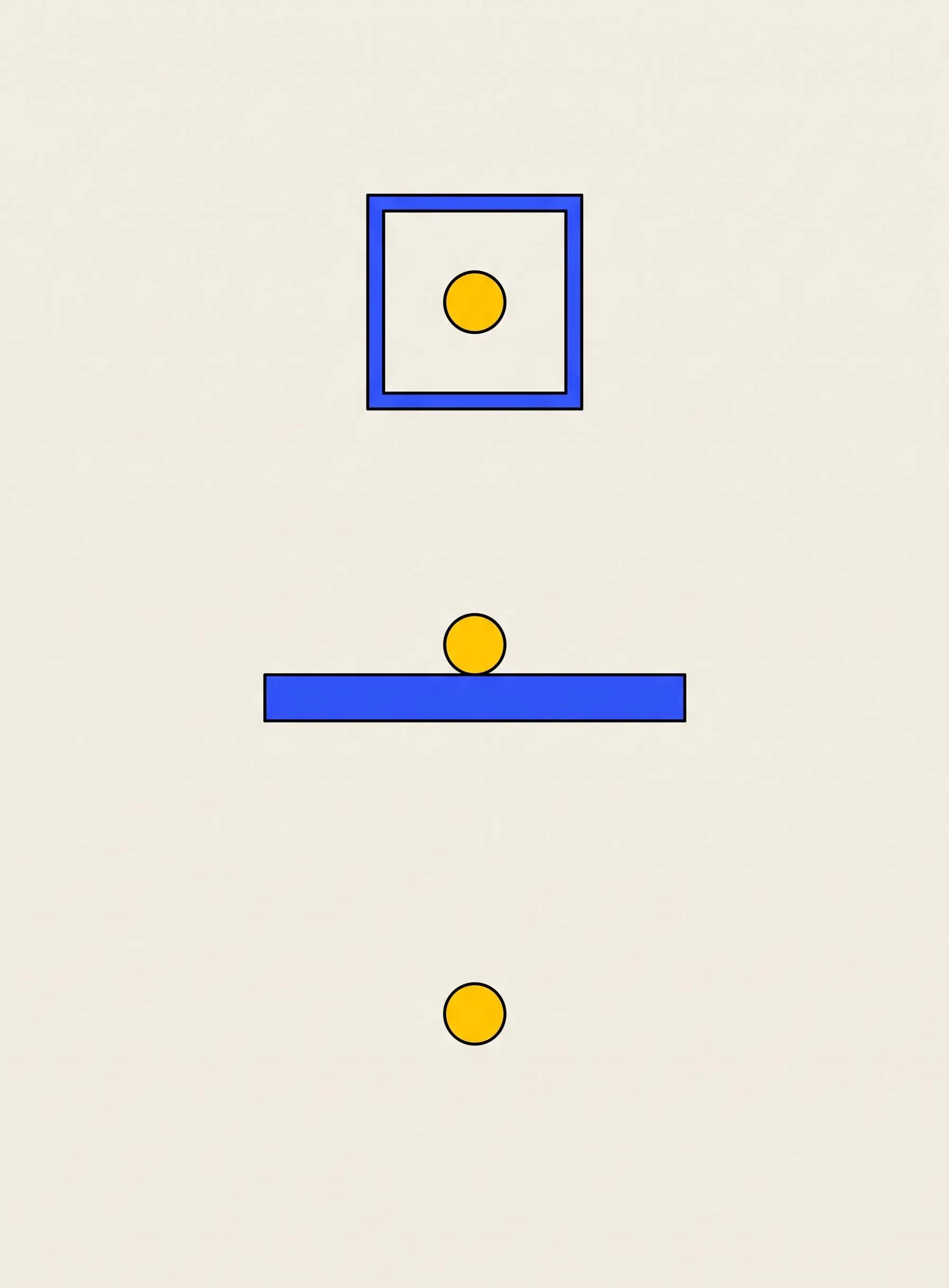
These three carry most of the traffic, and they come from a single question: how big is the thing you are picturing?
- in — an enclosed space, something with an inside. in the box, in the room, in the water, in Tokyo.
- on — contact with a surface. The surface does not have to be horizontal. on the table, on the wall, on the ceiling, on page 7.
- at — a point with no size, a coordinate rather than an area. at the door, at the bus stop, at the corner, at 42 King Street.
The part textbooks skip is the most freeing: the same place takes different prepositions depending on how the speaker pictures it. A station is a building and also a point on a map. I’ll meet you at the station treats it as a point; it’s warm in the station treats it as an enclosure. Both are correct. The preposition belongs to the mental picture, not to the noun — which means that for a great many sentences there are two right answers, and the hunt for the correct one was never necessary.
Two places where this logic quietly earns its keep:
- Vehicles. It is on the bus, on the train, on the plane but in the car, in a taxi. Not an arbitrary list — if you can stand up and walk about inside it, you are on a floor, so it takes on; seated and enclosed takes in. Bikes you climb onto: on a bike.
- Arriving. Arrive at the airport (a point) but arrive in Tokyo (a space you end up inside). And arrive to does not exist, though it is a common invention among learners whose language uses a directional marker there.
Now the payoff. English took that spatial system and reused it for time, unchanged. Big containers take in, single days are flat surfaces and take on, clock times are points and take at.
- in + long stretches: in 2026, in July, in the summer, in the morning
- on + days and dates: on Monday, on July 5th, on my birthday, on Christmas Day
- at + clock times: at three o’clock, at noon, at midnight, at lunchtime
Two exceptions are worth memorising: night is at night, not in the night, and the weekend splits by region — on the weekend in American English, at the weekend in British English.
One more habit to drop, nearly universal among learners: no preposition at all before next, last, this and every. It is see you next Monday, not on next Monday; I was busy last week, not in last week.
Read also: Inspiring English Quotes (With Meaning and How to Learn From Them)
Where your language splits the world differently
Some errors are personal to your first language, but three distinctions trip up learners from almost everywhere, because very few languages mark all three the way English does.
1. by, with, in — three kinds of “using”
- by is the method or route. by bus, by train, by email, by hand. Note it takes no article — by the bus means something different.
- with is the physical instrument you are holding. with a spoon, with a pen, with my hands.
- in is the form or medium something is cast in. in English, in pen, in cash, in bold.
So it is speak in English, never by English: a language is a container for the message, not a tool you grip. And when you describe how you achieved something, English uses by plus -ing: I improved by recording myself.
2. to and for — transfer versus benefit
Verbs where someone must receive the thing for the action to happen at all take to: give, send, tell, show, pass, explain. Verbs where you do something on another person’s behalf take for: buy, make, cook, get, find, book.
- I gave the book to her. — the book crossed over to her.
- I bought a book for her. — the book may still be in my bag; the buying was on her behalf.
This is why I made a cake to her sounds wrong to a native ear and for her sounds right. Baking is a service performed, not an object handed across.
3. from and of — origin versus material
Many languages use one marker for both. You are from a place (I’m from Brazil); a thing is made of a material when it still looks like it (made of wood) and from it when it has been transformed beyond recognition (wine is made from grapes).
The verbs that refuse a preposition
Most languages mark the thing being discussed, entered or married with some particle or case ending. English often does not — the verb takes its object bare. Adding a preposition here is the single most recognisable advanced-learner error, because it survives long after pronunciation and grammar have been cleaned up.
- discuss — We discussed the problem. Not discussed about. Meanwhile talk about and think about are correct, which is exactly why the rule cannot be guessed from meaning.
- mention — He mentioned the price. Not mentioned about.
- marry — She married him, or she got married to him. Never married with.
- enter — He entered the room. Not entered into — though enter into an agreement is a real and separate idiom.
- answer — Answer the question. Answer to someone exists but means to be accountable to them.
- attend — I attended the meeting. Attend to means to deal with or take care of something.
- contact — Please contact me. Not contact with me, although the noun phrase be in contact with is fine.
- resemble — He resembles his father. Not resembles with.
- reach — We reached the airport. Not reached to.
- explain — a half-exception. The thing explained is bare, the person takes to: Explain the rule to me. Not explain me the rule.
There is no principle hiding under this list, which is the useful thing to know about it: stop hunting for one and learn the ten. Two of them — discuss about and contact with — account for a large share of all preposition errors in professional English, and because they live in meetings and emails they repeat daily once the habit sets.
And the ones that collapse without it
The mirror-image error is just as common: English demands a preposition where your language attaches nothing. The classic case is hearing. English splits one idea into two verbs with different grammar — hear is involuntary and takes a bare object (I heard a noise), while listen involves attention and requires to (I listen to music). Listen music is one of the most persistent errors in the language.
These combinations are best treated as single vocabulary items:
- wait for someone, pay for something, apologise to someone for something
- look for (search), look at (direct your eyes), look after (care for) — the preposition carries the entire meaning
- depend on, belong to, consist of, graduate from, participate in, complain about, laugh at
- agree with someone but agree to a proposal — the preposition changes with what you are agreeing to
Adjectives behave the same way, and here there is genuinely no logic at all: interested in, good at, afraid of, proud of, tired of, worried about, similar to, different from, responsible for. Nobody can explain why it is good at rather than good in. There is nothing to understand, only something to store.
Which gives the most portable rule in this article: never learn a verb or adjective without its preposition attached. Write depend on ~ in your notes, not depend. As long as the preposition is a separate item you select at speaking time, you will keep selecting — and selecting under time pressure is where the error is made. This is the same principle that makes phrasal verbs learnable: verb and particle form one unit of meaning, and splitting them to study them destroys the thing you were learning.
The four pairs that change the meaning
Everything above produces English that sounds slightly foreign. These four pairs are different in kind: get them wrong and the other person understands something you did not say, agrees to it, and acts on it. Fix these first, whatever else you skip.
by vs until — deadline vs duration
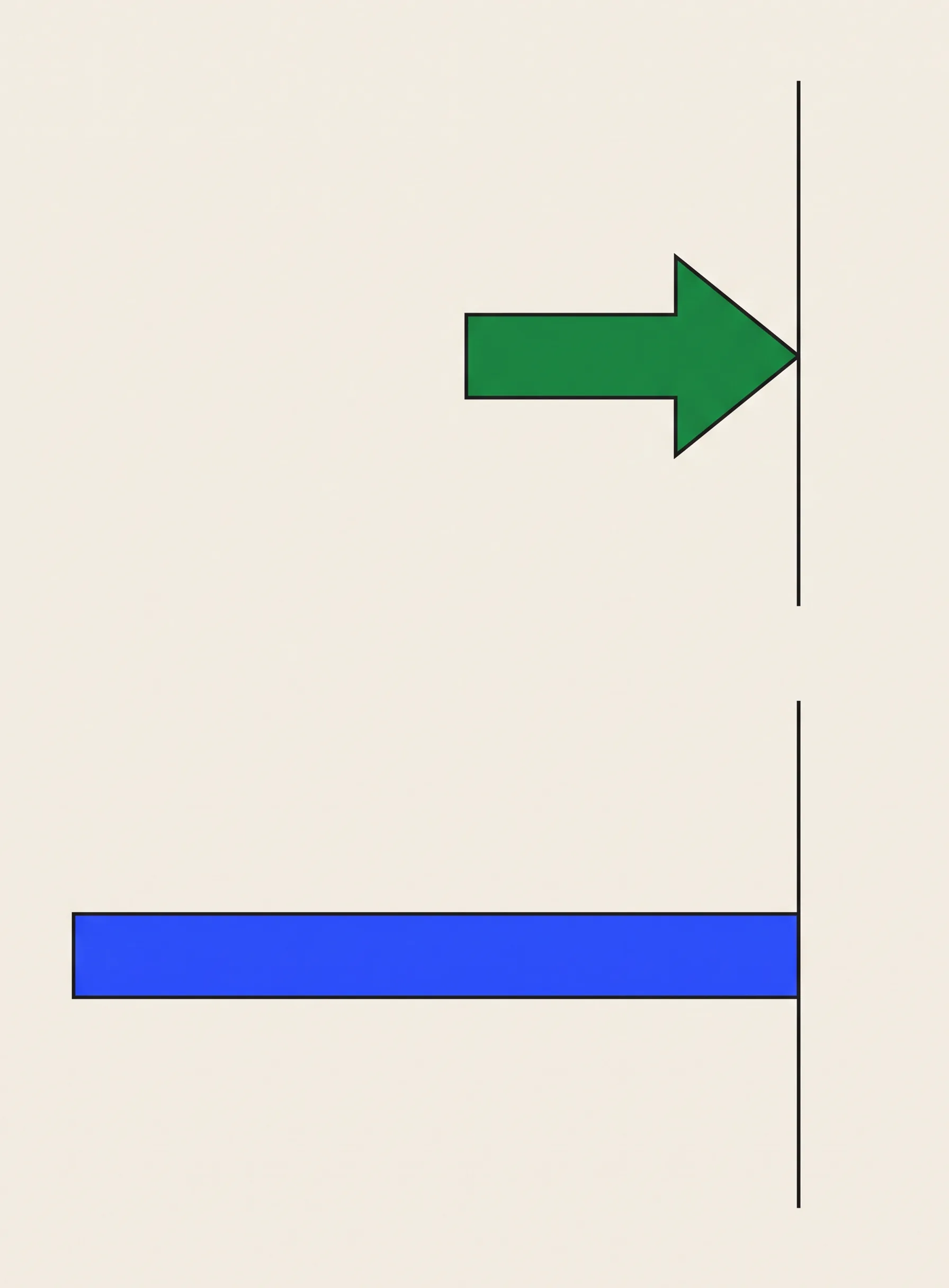
- Finish it by Friday. — complete it at some point before Friday. A deadline.
- I’ll wait until Friday. — the waiting continues up to Friday. A duration.
The test: if the action happens once and is over, use by; if it continues up to that moment, use until. Write send it until Friday to a colleague and you have asked them to keep sending it all week, and your deadline has silently vanished from the message. This is the most expensive preposition error in working English.
for vs during — length vs event
For takes a length of time: for three hours, for two weeks. If there is a number, it is for. During takes the name of an event or period: during the meeting, during the summer. So during three hours is wrong, and for the meeting is not a fix — it means in order to attend it. And while is not a preposition at all but a conjunction, so it needs a clause behind it: while I was eating, never while the meeting.
in vs after vs within — three ways to be late
- I’ll be back in two hours. — two hours from now. This is the one learners almost never reach for, and almost always need.
- After lunch, after the meeting. — after wants a named event, not a bare duration.
- Within two hours. — at some point inside that window.
I’ll call you after two hours makes a native listener pause, because it sounds like some two-hour thing must finish first. In two hours is what you meant.
since vs from — and the tense that comes with it
Since carries “from then until now” inside it, so it pulls the present perfect along: I’ve lived here since 2020. I live here since 2020 is wrong in the tense, not the preposition. From marks only a starting point: the shop is open from nine. To drill these as whole sentences rather than rules, English example sentences has the method.
How to actually fix your prepositions
Prepositions do not respond to studying tables, and the reason is specific: they are the one part of English you can get wrong without any consequence. The sentence still works, the listener still understands, nobody stops you. An error with no feedback loop can last twenty years. So the method has to manufacture the feedback that the language itself does not supply.
1. Find your ten before you study seventy. Open the last twenty messages you wrote in English and mark only the prepositions. The errors will be startlingly repetitive — most people have a personal set of eight to twelve that recurs for years. That list, not a textbook chapter, is your syllabus.
2. Store every verb with its preposition. Depend on ~, arrive at / arrive in, apologise to someone for something. A preposition stored as an independent word gets re-selected in every sentence at speed, and that is when it goes wrong.
3. Build the spatial picture before the time rules. Put three objects on your desk and describe where they are with in, on and at. Two minutes. Once the space system is intuitive, in July / on Monday / at three needs no separate memorisation — it is the same system pointed at a calendar.
4. Drill the four meaning-changing pairs. by/until, for/during, in/after, since/from. Everything else on this page makes you sound foreign; these four make you say the wrong thing.
5. Ask someone to correct only your prepositions. This is the part that cannot be done alone, and it is the whole game. Say I discussed about it to a native speaker and the conversation simply continues — they understood you, so correcting you would be both rude and pointless. The error is invisible by design. On CoffeeTalk you can ask your partner in advance to interrupt you for prepositions and nothing else. Narrowing the request is what makes it work: a vague “correct my mistakes” gets you nothing, while “only prepositions” is a job small enough to actually do. If the same one gets flagged twice in a conversation, you have found a fixed pattern, and writing it down usually ends it within a week.
One last expectation to reset. Prepositions never become perfect, and perfection is not the target. Native speakers disagree with each other — in the street against on the street is regional, and at the corner and on the corner are both fine. The aim is narrower and entirely reachable: eliminate the errors that change your meaning, attach the common verbs to their particles, and let the rest sit inside the range where native speakers vary anyway. The other sixty never mattered.
FAQ
Why are English prepositions so hard to learn?
Because they are usually learned as a translation table, and no such table works. A single English preposition covers jobs that your own language spreads across three or four different words — in alone handles location, containment, medium, future points and states. Converting from your language therefore means picking from several options with nothing telling you which applies. The fix is to learn the spatial idea behind each preposition and extend it to time, and to store the rest attached to their verbs rather than as independent words.
What is the difference between in, on and at?
It comes down to how big the thing is in your mental picture. In is an enclosed space with an inside (in the box, in Tokyo). On is contact with a surface, horizontal or not (on the table, on the wall). At is a point with no size, a coordinate rather than an area (at the door, at the bus stop). The same place can take different ones: meet me at the station treats it as a point, it’s warm in the station treats it as a building. English then reuses the same system for time — in July, on Monday, at three o’clock.
Why is ‘discuss about’ wrong?
Because discuss takes its object directly: we discussed the problem. Most languages mark the topic with a particle or preposition, which is why learners add about almost automatically. The same verbs behave this way in English: mention, marry, enter, answer, attend, contact, resemble and reach all take a bare object. Confusingly, talk about and think about do require about, so there is no rule to deduce — this short list is simply worth memorising as a list.
What is the difference between by and until?
By is a deadline and until is a duration. Finish it by Friday means complete it at some point before Friday. I’ll wait until Friday means the waiting continues up to Friday. The test is whether the action happens once and ends (by) or continues to that moment (until). This matters more than any other preposition pair because getting it wrong changes the message rather than just the accent — send it until Friday reads as an instruction to keep sending all week, and your deadline disappears.
How can I stop making preposition mistakes when I speak?
Three things. First, audit your own writing and mark only the prepositions — most people have a fixed personal set of about ten errors, and that list is your real syllabus. Second, store prepositions attached to their verbs (depend on ~, not depend), because anything stored separately gets re-chosen under time pressure and that is when it fails. Third, get explicit correction, since preposition errors never interrupt communication and so are never corrected spontaneously. Ask a conversation partner to flag prepositions and nothing else; narrowing the request is what makes people actually do it.