
English speaking
How to Master English Conversation: A Practical Guide to Actually Speaking

Almost every English learner hits the same wall: you can read articles, follow films with subtitles and ace grammar quizzes — but the moment a real conversation starts, your mind goes blank. If that’s you, nothing is wrong with your English. You’ve just been training a different skill.
Conversation is its own skill, separate from grammar and reading, and like any skill it improves through the right kind of practice — not more theory. This guide breaks down how to actually master spoken English: why speaking feels so much harder than understanding, how to feed your brain the right input, how to force output, and a simple daily routine that ties it all together.
Why conversation is a separate skill
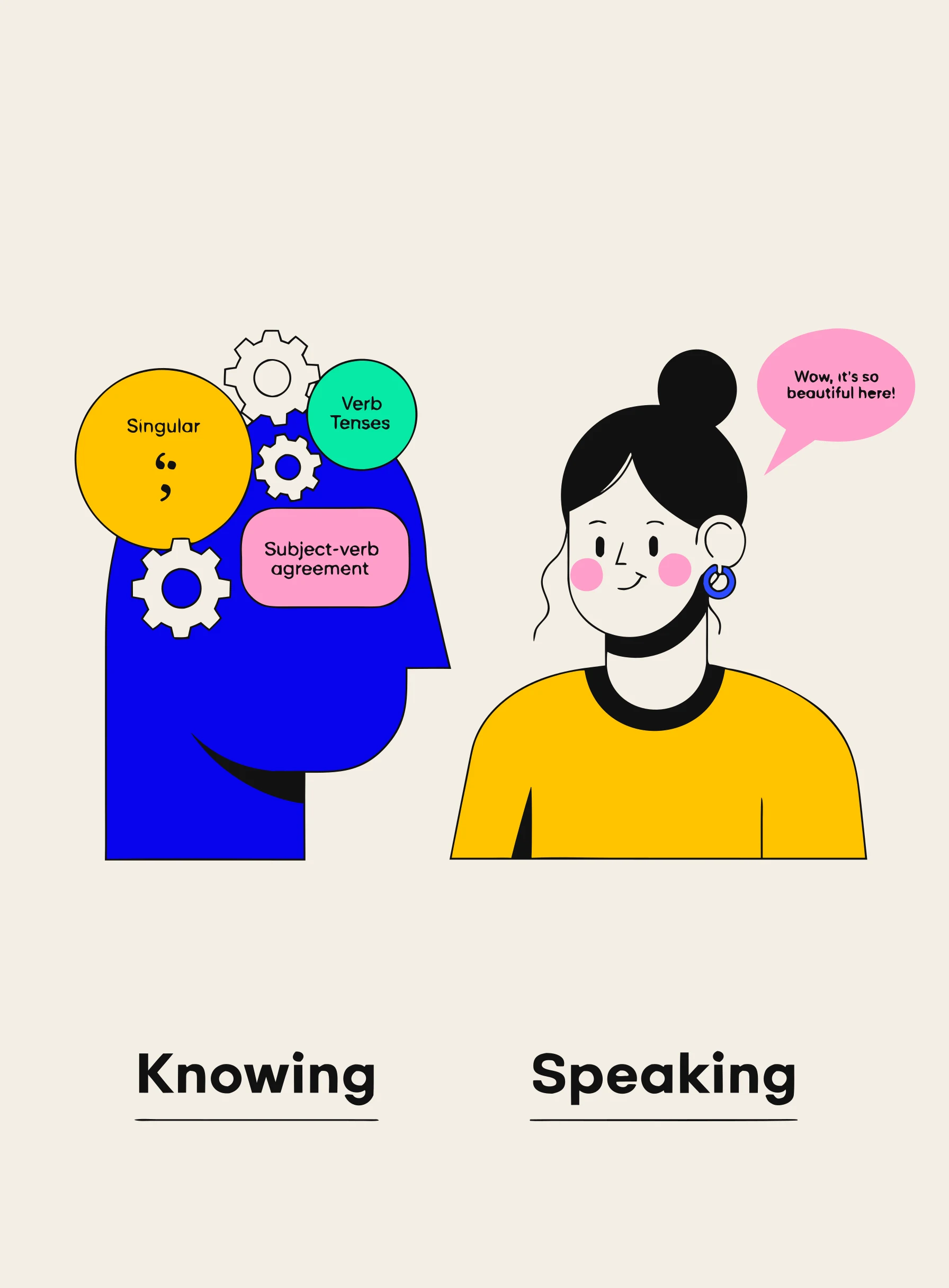
Here’s the truth behind the ‘I understand but can’t speak’ problem: understanding and speaking use your language knowledge in opposite directions.
- Understanding is recognition. The words arrive and you match them to meaning. You have all the time the speaker gives you, and context fills the gaps.
- Speaking is production. You have to summon the words, order them, and get them out — in real time, with no pause button.
That’s why a learner with excellent grammar can still freeze mid-sentence: grammar you can recognise isn’t the same as grammar you can produce under pressure. The fix isn’t more rules — it’s practising the production side directly. If this is your exact struggle, we go deeper in why you understand but can’t speak.
Input: fill your head with real English
You can’t pour out what you never poured in. Before words can become active — ready on your tongue — they have to enter as input you’ve met many times. The trick is to make that input the kind you’ll actually reuse in conversation:
- Choose spoken-style input. Podcasts, interviews, vlogs and dialogue-heavy shows teach you how people really talk — far better than formal written English.
- Favour comprehensible input. Pick material you understand roughly 80% of, so you meet new words in a context clear enough to guess them.
- Repeat, don’t just consume. Re-listening to the same clip a few times cements phrases better than racing through new material once.
Good input is the raw stock of conversation. The more natural, spoken English you take in, the more phrases you’ll have ready when it’s your turn to talk.

Read also: Telephone Conversation in English: Scripts for the Calls You Actually Have to Make
Output: the part you can't skip
This is where most learners stall — and where fluency is actually built. Output means producing English yourself: speaking and writing, not just absorbing. It’s uncomfortable, which is exactly why it works.
Every time you force a word from passive recognition into active use, you strengthen the pathway that lets you retrieve it next time. Ways to push output, from gentle to real:
- Talk to yourself. Narrate your day, describe what you’re doing, think out loud in English. No audience, no pressure.
- Write short, then say it. Journal a few sentences, then read them aloud so the words hit your mouth, not just the page.
- Speak with a real person. Nothing else forces real-time retrieval like a live conversation where someone is waiting for your reply.
That last one is the accelerator. Everything before it is preparation; talking with a real partner is where preparation turns into ability.

Speak in chunks, not word by word
Fluent speakers don’t build sentences one word at a time — they reach for ready-made chunks: little blocks of words that come out as a unit. This is the single biggest shortcut to sounding natural and speaking faster.
- Instead of assembling ‘How… are… you… doing’, you fire off ‘How’s it going?’ as one piece.
- Learn phrases like ‘I was about to…’, ‘Do you mind if…’ and ‘the thing is…’ whole, with a slot to fill.
- Collect the chunks you hear in real conversations and reuse them — they’re proven, natural, and grammatically correct by default.
Chunks take the pressure off. Instead of solving a grammar puzzle every sentence, you drop in a block you already trust — faster to say and easier for the listener to follow. Our guide to everyday English phrases is a ready-made starter set.
A simple daily routine
Mastery comes from small, repeated reps, not occasional marathons. A workable daily loop looks like this:
- 10 minutes of input. Listen to a short, spoken-style clip — and re-listen once.
- 5 minutes of chunks. Pull two or three useful phrases from what you heard and say them aloud in your own sentences.
- 10–15 minutes of output. Talk: to yourself, or far better, to a real partner.
Half an hour a day, done consistently, beats a three-hour cram once a week — because a language lives in frequent retrieval, not in long, rare sessions. For a fuller plan, see how to study English conversation and how to practise speaking a new language.
From studying to speaking
You can do the input and the chunks alone, but the one step that truly builds conversation — real-time output with another human — needs a partner. That’s the piece no app or textbook can replace, and it’s where studying finally becomes speaking.
That’s exactly what CoffeeTalk is built for. Every member passes a quick video verification, so you’re practising with a real person who’s there to talk. You’re matched near your level and given ready-made topics, so you’re never staring at silence wondering what to say. Do the input on your own, then bring your reps here — where they turn into real conversation.

FAQ
Why can I understand English but not speak it?
Because understanding and speaking are different skills. Understanding is recognition — you match incoming words to meaning at the speaker's pace. Speaking is production — you have to summon and order words yourself in real time. Grammar you can recognise isn't automatically grammar you can produce, so speaking needs its own practice.
How can I practise English speaking by myself?
You can do a lot alone: narrate your day out loud, describe what you're doing, think in English, and read short things you've written aloud. This builds active production. But real-time conversation with another person is the one part you can't fully replicate solo, so combine solo drills with real speaking practice.
How long does it take to become fluent in English conversation?
It depends on your starting level and how much you actually speak, but consistency matters far more than total hours. A focused 30 minutes a day of input plus real output will move you faster than occasional long study sessions, because conversation improves through frequent retrieval, not cramming.
What are chunks in English speaking?
Chunks are ready-made blocks of words that come out as a single unit — phrases like 'How's it going?', 'I was about to…', or 'Do you mind if…'. Fluent speakers rely on them instead of building every sentence word by word, which makes speech faster, more natural, and grammatically correct by default.
What's the best way to master English conversation?
Combine three things daily: take in natural, spoken-style input; learn and reuse useful phrase chunks; and force output by speaking, ideally with a real partner. Understanding fills your head, but only producing English out loud under real-time pressure turns that knowledge into actual conversation ability.