
Korean greetings
How to Say Hello in Korean: 10 Ways from Formal to Casual

You’ve decided to learn a little Korean — maybe for a trip, a drama, a friend, or a language exchange — and the very first thing you’ll ever need is also the friendliest: hello. The catch is that Korean doesn’t have a single ‘hello’. Which greeting you choose depends on who you’re talking to and how well you know them.
That sounds intimidating and really isn’t. Below are ten ways to say hello in Korean — from the formal 안녕하십니까 to the casual 안녕 — with pronunciation, when to use each, and the small piece of etiquette that turns a textbook phrase into a real greeting.
안녕하세요: the greeting that works almost anywhere
If you learn only one Korean greeting, make it 안녕하세요 [an-nyeong-ha-se-yo]. It’s the polite, all-purpose ‘hello’ you can use with almost anyone — a shopkeeper, a colleague, your friend’s parents, a stranger — at almost any time of day. It literally asks whether the other person is ‘at peace’, and it carries none of the risk of sounding too stiff or too familiar.
A few things worth knowing:
- It works morning, noon, and night — Korean has no separate ‘good morning / good afternoon / good evening’ for everyday use.
- Say it with a small nod or bow and it instantly looks natural.
- The last syllable rises slightly, almost like a gentle question.
Master this one phrase and you can walk into ninety per cent of situations and greet anyone correctly. Everything below is just fine-tuning.

The three levels: formal, polite, and casual
Korean politeness runs on levels, and greetings are where you first feel it. The same ‘hello’ comes in three main strengths:
- 안녕하십니까 [an-nyeong-ha-sim-ni-kka] — formal. The most respectful hello, used in job interviews, announcements, the military, news broadcasts, and any setting that calls for real deference. Say it to a very senior person you’re meeting for the first time and you can’t go wrong.
- 안녕하세요 [an-nyeong-ha-se-yo] — polite. The everyday default from the section above. Respectful without being stiff.
- 안녕 [an-nyeong] — casual. A relaxed ‘hi’ for close friends, people clearly younger than you, and children. Used with the wrong person it sounds too familiar, so save it for people you’re genuinely close to.
The rule of thumb: when in doubt, go one level more polite. Koreans will never be offended that you were too respectful, but the reverse can sting. As you get to know someone, they may tell you it’s fine to drop from 안녕하세요 to 안녕 — that little permission is its own small milestone.
Read also: How to Say Thank You in Korean (Formal, Casual and In Between)
Greetings for specific moments
Beyond the everyday hello, a handful of situational greetings will make you sound far more natural:
- 여보세요 [yeo-bo-se-yo] — ‘hello?’ on the phone only. Don’t use it face to face.
- 만나서 반갑습니다 [man-na-seo ban-gap-seum-ni-da] — ‘nice to meet you’, for first introductions.
- 오랜만이에요 [o-raen-man-i-e-yo] — ‘long time no see’, when you reconnect with someone.
- 잘 지냈어요? [jal ji-naess-eo-yo] — ‘how have you been?’, a warm follow-up to a greeting.
- 어서 오세요 [eo-seo o-se-yo] — ‘welcome’, what shop and restaurant staff call out as you walk in. You’ll hear this constantly; you don’t need to say it back.
Notice that Korean folds ‘how are you?’ into the greeting far less automatically than English does — 안녕하세요 already carries that warmth, so you don’t need to tack on a question every single time.

The etiquette: a nod, a bow, and your hands
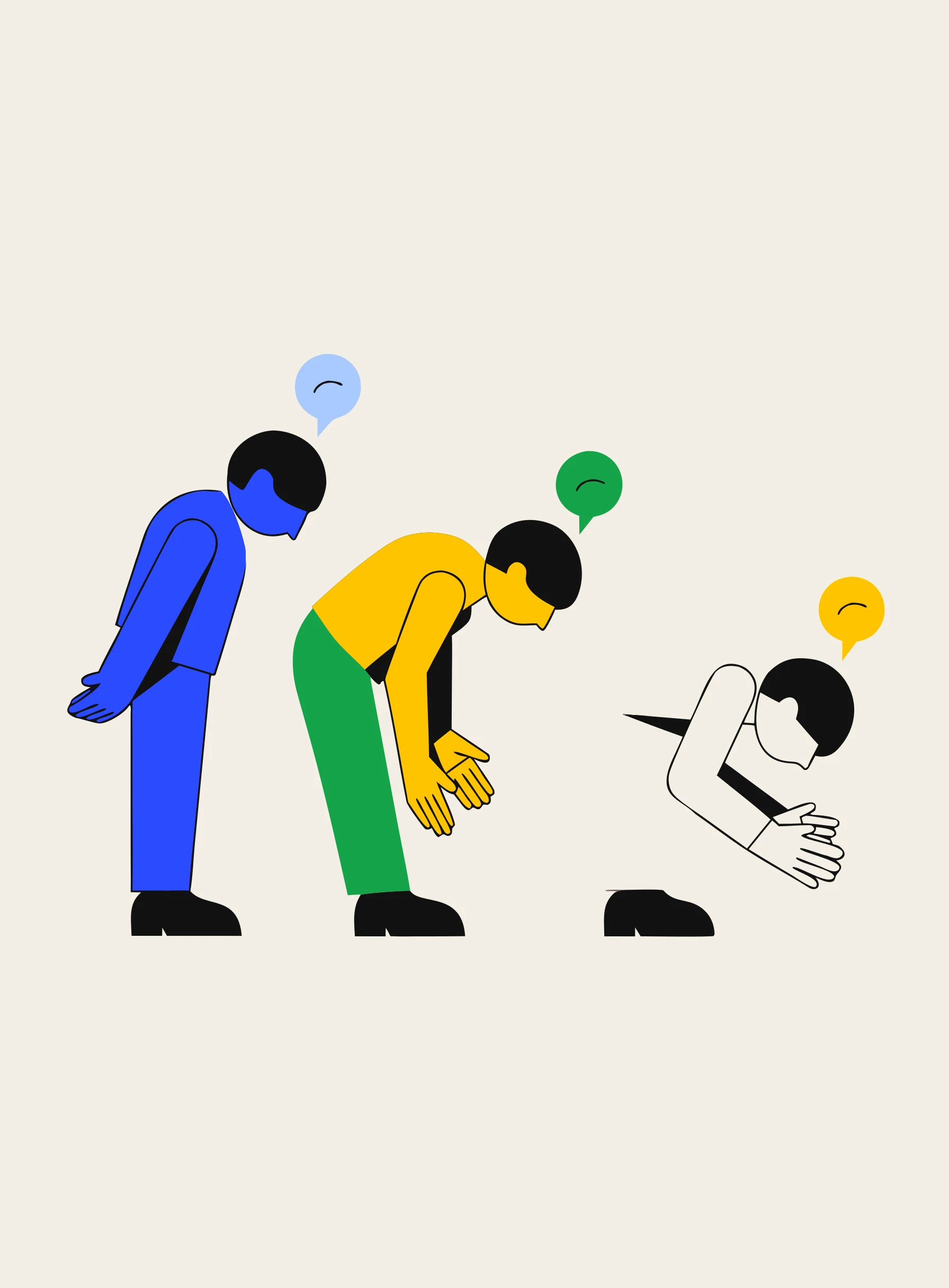
In Korean, how you greet matters almost as much as the words. A greeting is usually paired with a small bow, and the depth tells the other person how much respect you’re showing:
- A quick nod of the head — friends and casual settings.
- A 15-to-30-degree bow from the waist — the everyday polite bow that goes with 안녕하세요.
- A deeper bow — for elders, senior colleagues, or formal apologies and thanks.
Two small habits make you look like you know what you’re doing: keep your hands relaxed at your sides or lightly clasped in front, and when you shake hands — common in business — lightly support your right forearm with your left hand as a sign of respect. None of this needs to be perfect; the effort itself reads as politeness.
How to answer when someone greets you
Often the simplest reply is to mirror the greeting back: someone says 안녕하세요, and you say 안녕하세요 with a nod. That alone is completely correct. To keep the exchange going, a few natural follow-ups:
- 네, 안녕하세요 [ne, an-nyeong-ha-se-yo] — ‘yes, hello’, a warm acknowledgement.
- 네, 잘 지내요 [ne, jal ji-nae-yo] — ‘yes, I’m doing well’, if they ask how you’ve been.
- 반갑습니다 [ban-gap-seum-ni-da] — ‘pleased to meet you’, after an introduction.
The most important thing isn’t the perfect phrase — it’s answering at all, promptly and with a smile. A slightly imperfect greeting said warmly beats a flawless one you hesitated three seconds too long to deliver.
From word list to real conversation
Reading a list of Korean greetings is the easy part. The moment that actually counts is the first time a real person says 안녕하세요 and looks at you, waiting — and that only gets comfortable by doing it, out loud, more than once. A word list can’t give you that; a real conversation can.
That’s the gap CoffeeTalk is built to close. Every member passes a quick video verification, so the Korean speaker you greet is a real person there to practise — not a bot or a borrowed photo. You’re matched near your level so the pressure stays low, and handed ready-made topics so the conversation keeps moving after that first 안녕하세요. If you want a wider set of drills to build on, see our guide on how to practise speaking a new language — and when you’re ready to say more than hello, our guide on how to introduce yourself maps neatly onto Korean too.

FAQ
How do you say hello in Korean?
The most useful way to say hello in Korean is 안녕하세요 (an-nyeong-ha-se-yo), a polite, all-purpose greeting you can use with almost anyone at any time of day. For very formal settings use 안녕하십니까, and with close friends you can simply say 안녕.
What is the difference between 안녕하세요 and 안녕하십니까?
Both mean hello, but 안녕하십니까 is more formal and respectful — used in interviews, broadcasts and with senior people — while 안녕하세요 is the polite everyday version for almost every situation. When you're unsure which to use, the more formal one is always safe.
Can I just say 안녕 in Korean?
Only with people you're close to or clearly younger than you, such as good friends, siblings or children. 안녕 is casual, so using it with strangers, elders or seniors can sound too familiar. With everyone else, use 안녕하세요.
How do you answer the phone in Korean?
Koreans answer the phone with 여보세요 (yeo-bo-se-yo), which means hello but is used only on the phone — not face to face. On a business call you might follow it with your name or your company's name.
Do I need to bow when saying hello in Korean?
A small bow or nod usually goes with a Korean greeting and is a sign of respect. A quick nod suits friends, a 15-to-30-degree bow suits polite everyday greetings, and a deeper bow suits elders and formal settings. The gesture matters, but it doesn't need to be perfect.