
Korean culture
What Does “Maknae” Mean? The K-pop Term for the Youngest, Explained

Scroll through any K-pop fan thread and you’ll see it constantly: someone calls a member the maknae (막내). If you’ve wondered whether that’s a nickname, a role or an insult — relax, it’s none of those.
The short version: maknae means the youngest — the youngest member of a group, a family, a team, or any set of people. In K-pop it’s become a beloved label for the baby of the group, and it comes with its own culture: the ‘maknae line’, the ‘golden maknae’, and a whole set of expectations about how the youngest behaves. Here’s what maknae really means and how Koreans actually use it.
What “maknae” actually means
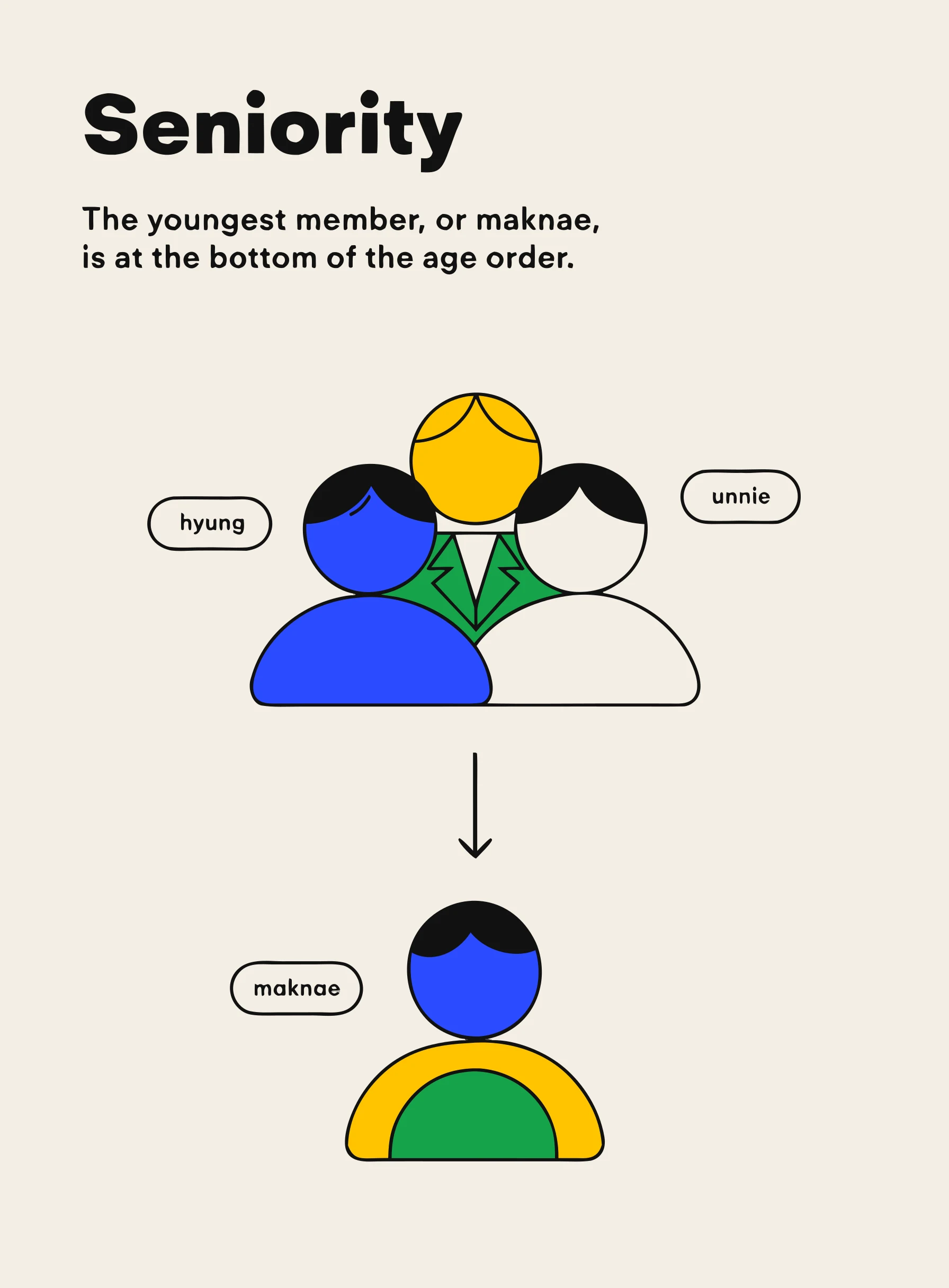
Maknae (막내) is the Korean word for the youngest person in a group. That group can be almost anything: a family’s youngest child, the youngest employee on a team, the youngest of a friend circle — or the youngest member of a K-pop band.
A couple of things to keep straight:
- It’s about being last-born in the group, not about being a child. A thirty-year-old can be the maknae of their office if everyone else is older.
- It’s gender-neutral. The youngest is the maknae whether they’re male or female — unlike oppa or unnie, the word doesn’t change.
So when fans call an idol ‘the maknae’, they simply mean that person is the youngest in the group. Everything else — the cuteness, the teasing, the special treatment — is culture layered on top of that one plain fact.

The “maknae line” in K-pop
Fans don’t just talk about the maknae — they talk about the maknae line. In a group with several members, the maknae line is the cluster of youngest members, as opposed to the older members (often called the ‘hyung line’ or ‘unnie line’).
- The maknae line = the youngest members of the group.
- The hyung line / unnie line = the oldest members.
There’s no fixed cut-off; fans draw the line by the age gaps inside each specific group. And within the maknae line, the single youngest member holds a title of their own — sometimes crowned the ‘golden maknae’ when they turn out to be gifted at nearly everything: singing, dancing, sports, you name it.

Read also: What Is “Aegyo”? Korea's Cutest Concept, Explained
Maknae vs hyung, unnie and the older members
Maknae sits at one end of Korea’s age-based structure, and it helps to see where it fits against the sibling-style words fans throw around:
- 막내 (maknae) — the youngest member, any gender.
- 형 (hyung) — an older male, used by a younger male.
- 누나 (noona) — an older female, used by a younger male.
- 오빠 (oppa) — an older male, used by a younger female.
- 언니 (unnie) — an older female, used by a younger female.
Notice the difference: hyung, noona, oppa and unnie describe a relationship between two people and depend on who’s speaking. Maknae is simpler — it’s a position in the group. The maknae stays the youngest no matter who’s talking to them. For the full breakdown of those older-sibling terms, see our guide on what oppa really means.
Why the maknae gets babied
Here’s the part that gives the word its charm. In Korean group culture, age comes with a soft trade: older members look after younger ones, and the youngest — the maknae — gets a little extra warmth, patience and teasing in return. On variety shows this becomes a running joke: the maknae is doted on, protected, and gently bossed around all at once.
A few things tend to cluster around the maknae:
- Aegyo. The youngest is often expected to lean into aegyo — a cute, charming way of acting — and fans adore it.
- Being spoiled. Older members buy the maknae food, cover for them, and let them get away with a little more.
- The maknae-on-top trope. A cheeky maknae who teases the elders back is a fan favourite — it flips the hierarchy for laughs.
None of this is in the dictionary definition. It’s the culture that has grown up around the word — which is exactly why maknae feels so affectionate to fans.
Using maknae in real life
Outside of K-pop, maknae is an everyday word Koreans use without a second thought. The youngest child in a family is the maknae. The newest, youngest hire in an office is often the team maknae — and yes, that sometimes means being the one sent on coffee runs.
A couple of quick notes if you ever use it:
- It’s warm and informal, so it suits friends and familiar settings, not formal introductions.
- You can be a maknae in one group and not another — youngest at work, but an older sibling at home.
So the word travels far beyond idol groups. Any time there’s a clear youngest, there’s a maknae.
From knowing the word to using it
You now know maknae better than most casual fans — but recognising a word and dropping it naturally into a real Korean conversation are two different things. That gap closes fastest in one way: talking with real Korean speakers who show you which word fits which moment.
That’s what CoffeeTalk is for. Every member passes a quick video verification, so you’re practising with a real person who’s there to talk — not a bot. You’re matched near your level and handed ready-made topics, so there’s always something to say. New to Korean? Pair this with our guides on how to say hello in Korean and how to practise speaking a new language.

FAQ
What does maknae mean in Korean?
Maknae (막내) means the youngest person in a group — the youngest child in a family, the youngest member of a team, or the youngest member of a K-pop group. It's gender-neutral and describes a position (being the last-born of the group), not an age or a personality.
What is the maknae line?
The maknae line is the group of youngest members in a K-pop band, as opposed to the older members, who are sometimes called the hyung line or unnie line. There's no fixed age cut-off — fans draw the line based on the age gaps within each specific group.
What is a golden maknae?
A golden maknae is the youngest member of a group who turns out to be gifted at almost everything — singing, dancing, sports and more. The word 'golden' is added to highlight that the maknae excels far beyond what's expected of the youngest.
Is maknae only used for K-pop?
No. Maknae is an everyday Korean word for the youngest person in any group. The youngest child in a family is the maknae, and the youngest employee on a team is often called the team maknae. K-pop simply made the word famous internationally.
What's the difference between maknae and oppa?
They describe different things. Maknae is a position — the youngest member of a group, regardless of gender. Oppa is a relationship word a female uses for an older male. Maknae stays the same no matter who's speaking, while oppa depends on the speaker's gender and the other person's age.