
English phrases
English Conversation Sentences: 48 That Keep the Other Person Talking
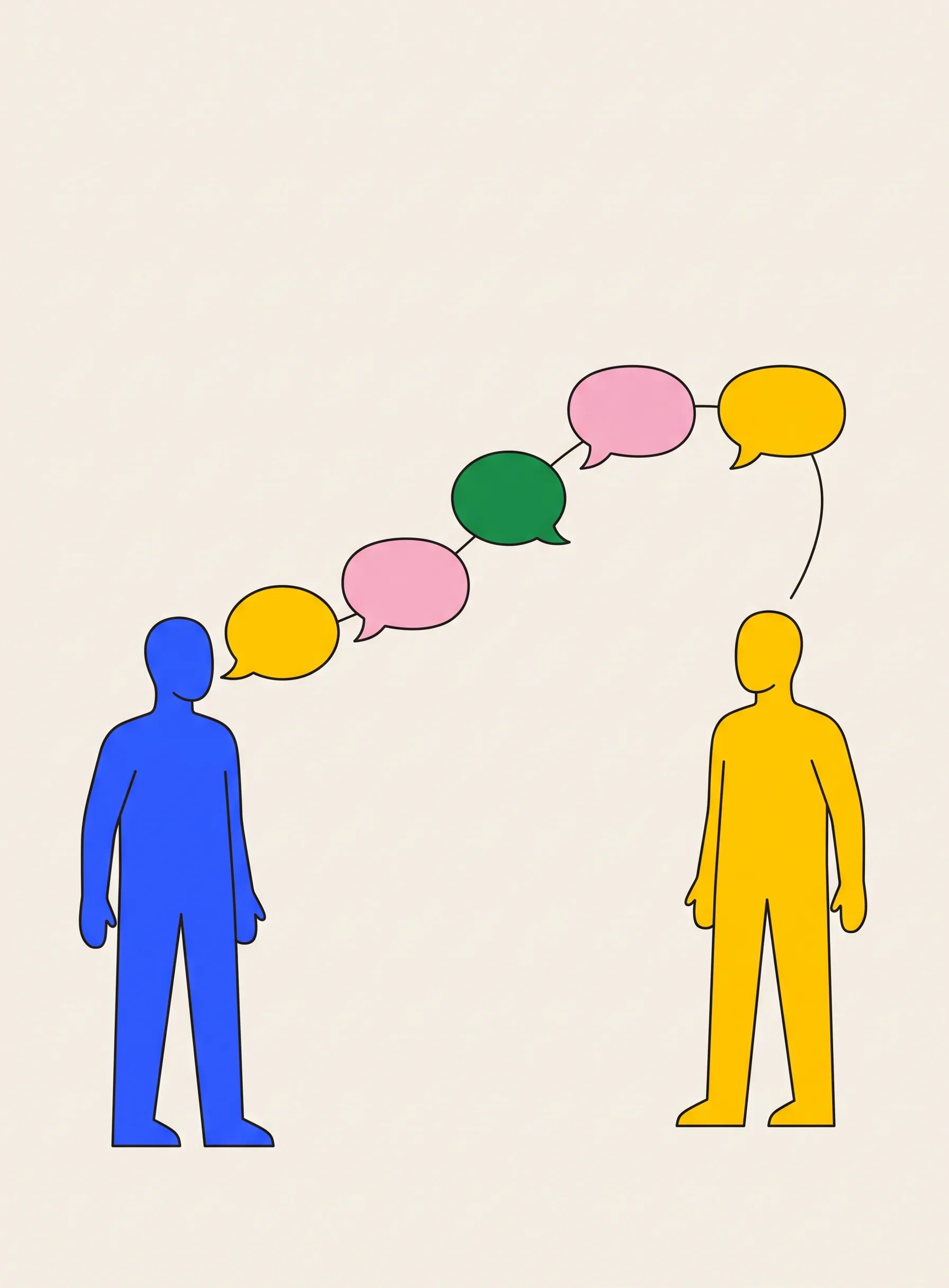
You can introduce yourself. The sentences you prepared come out fine. Then the other person answers, your mind goes flat, and three seconds later you produce ‘Oh, really? Nice.’ The conversation stops there. If you have collected hundreds of English conversation sentences and this still happens weekly, the problem is not how many you know.
A conversation does not run on the things you planned to say. It runs on three other kinds of sentence: reacting to what you just heard, catching a piece of it and asking about that, and recovering when you missed a word. Almost every phrasebook teaches the first kind of sentence — the ones you initiate — and almost none teach the other three. This guide covers those: 48 sentences you can use in the next week, grouped by the moment they belong to, plus the reason memorised sentences refuse to appear and the routine that fixes it.
Why the words are there and the sentence isn’t
Most learners past the beginner stage have plenty of sentences for speaking. What they are missing are sentences for the moment right after listening. That gap is where conversations die, and it dies in a small number of predictable places.
- They answered and you have nothing to catch it with. ‘I went to Lisbon last weekend.’ If Oh, really? is the only thing available, the exchange is over in one move.
- One word goes missing and the whole sentence stalls. Without a repair sentence you smile and nod, and from that point you are performing a conversation rather than having one.
- You compose the sentence fully in your head first. By the time it is finished and translated, the topic has moved two steps on and the sentence no longer fits anywhere.
None of these is a vocabulary problem. Really, sorry and mean are words you have known for years. The problem is that they are not stored as chunks that come out whole. Fluent speakers do not assemble most of what they say in a conversation either; they retrieve prebuilt pieces, which is precisely why they sound fast.
So the target changes. Not ‘know more sentences’, but have one automatic sentence for each of the thirty situations that keep recurring. The lists below are organised by situation for that reason — the trigger matters more than the sentence.
14 reaction sentences: the shortest and the most important
The sentences that save a conversation are almost all short, because they have to arrive within about half a second of the other person finishing. Two words delivered quickly beat a well-formed sentence that arrives late — a pause reads as disinterest long before a grammar mistake reads as bad English.
Surprise
- No way! — the most common and the most flexible.
- Are you serious? — a stronger version.
- That’s crazy. — works for good news and bad news equally.
- Wait, really? — the wait is what makes it sound native rather than textbook.
Agreement and recognition
- Same here. — more conversational than me too.
- I know what you mean. — softer than agreeing outright; you are recognising the feeling, not endorsing the claim.
- That makes sense. — for accepting an explanation.
- Tell me about it. — strong agreement, and a trap: it does not mean ‘please tell me about it’. It means ‘you don’t have to, I already know’.
Sympathy
- Oh no, that’s too bad.
- That must have been tough. — for something already over.
- I’m sorry to hear that. — slightly more formal; fine at work.
Good news
- That’s awesome!
- Good for you! — genuine praise when the tone is warm, and the exact opposite when it is flat. Intonation carries the whole meaning.
- Congrats! — the everyday form of congratulations.
Take five of these and own them completely rather than half-knowing all fourteen. In a real conversation, five reflexes beat fourteen recognitions every time.
12 follow-up sentences that hand the turn back
Reacting alone still ends the exchange. Adding one question after the reaction restarts it, and the question is usually built from a word the other person just said.
Them: ‘I went to Lisbon last weekend.’
You: ‘Oh nice! What did you do there?’
The structure never changes: reaction, then question. These are the questions worth having ready.
- What was it like? — the universal one. A trip, a film, a new job, a first day, a person.
- How was it? — the shorter version.
- How did that go? — for anything with an outcome: an exam, an interview, a presentation.
- What made you decide to do that? — asks the reason more gently than why, which can land as a challenge.
- How long have you been doing that? — for hobbies and jobs.
- Since when? — the compressed version, informal.
- What do you mean by that? — genuinely curious, not confrontational, as long as the tone is light.
- And then what happened? — keeps a story moving.
- Do you do that often?
- Is that normal where you’re from? — the door into culture, and it usually buys you five minutes.
- What about you? / How about you? — passing the turn back. One of the most-used sentences in spoken English.
- Wait, back up — you said you moved twice? — returning to something from earlier. This one signals that you were genuinely listening, which is worth more than any other question here.
Practise the reaction and the question as one chunk, on one breath: Oh nice, what was it like? is a single unit, not two sentences. Split them and the pause between will do the damage you were trying to avoid.
10 sentences for when you missed it
The most useful category and the one almost nobody drills. Miss a word, smile, nod, and the conversation becomes scenery. Native speakers ask each other to repeat several times a day; asking is not evidence of weak English, it is the skill that keeps the conversation real.
When you missed the whole thing
- Sorry, could you say that again? — the safe default, correct anywhere.
- Sorry? — rising intonation. One word is enough.
- I didn’t catch that. — natural and extremely common.
- Could you slow down a little? — when speed is the real problem. Nobody minds being asked.
When you missed one part — far more efficient, because hearing the whole sentence again usually means failing on the same word twice.
- Sorry, you went where? — put the question word exactly where the hole is.
- You said Thursday? — repeat only the piece you want confirmed.
- Sorry, what does ‘commute’ mean? — when the word itself is new. Asking is always better than guessing.
When you are the one stuck
- Does that make sense? — checks that you were clear. Prefer it to do you understand?, which can sound like a test of the listener.
- Sorry, how do I say this… — buys you a few seconds out loud, which is far more natural than silence.
- What’s the word for when…? — the escape hatch when the word will not come: what’s the word for when you can’t sleep at night?
Those last two matter more than they look. Learners tend to abandon the whole sentence when one word goes missing; fluent speakers talk around the gap and finish the sentence anyway. Changing that single habit visibly reduces how often you stall.
12 sentences for opening, steering and ending
The beginning and end of a conversation have the least variation, which means they are the part where memorised sentences work perfectly. Automate these first; the return is immediate.
Opening
- Hey, how’s it going? — the standard greeting. Good, you? is a complete answer. It is not a real question about your wellbeing.
- How have you been? — for someone you have not seen in a while.
- Sorry I’m a bit late. — needed constantly in online conversations.
- Can you hear me okay? — the first sentence of most video calls.
- So, where should we start? — moving into the substance.
Steering mid-conversation
- Oh, that reminds me — — the easiest way to change subject without it feeling abrupt.
- Speaking of which… — building on what was just said.
- Can I ask you something? — a cushion before a question.
- Sorry, go ahead. — when you both spoke at once. Essential online, where the lag guarantees it happens.
Ending
- I should probably get going. — the standard exit.
- It was really nice talking to you. — closes any conversation safely.
- Let’s do this again. — if you mean it.
That is 48 sentences. The gap between reading a list like this and having the sentences arrive on time is what the next two sections are about — there is more raw material in everyday English conversation phrases and daily English sentences, but processing these 48 will do more for you than collecting another fifty.
Why memorised sentences never come out (and why correct ones sound wrong)
The sentence is in the notebook and not in your mouth. Usually for one of four reasons.
- You stored a sentence instead of a frame. Memorise what was it like? and you own one sentence. Store it as what was [ ] like? and you own what was the food like?, what was your first day like?, what was he like? and thirty more. Every sentence on this page has a slot in it somewhere; find the slot before you memorise it.
- You only met it with your eyes. A sentence you have read is available for listening and unavailable for speaking, because your mouth has never built it. Five times out loud beats ten times silently, and it is not close.
- You stored it without its trigger. A sentence on its own leaves you deciding when to use it, and that decision costs two seconds you do not have. Store the pair: they mention their weekend → what was it like? Reflexes are built from trigger-and-response, not from responses alone.
- You took thirty at once. Thirty sentences today is zero sentences next week. Five a week is the rate that survives, and it compounds to 250 a year, which covers most of ordinary conversation.
The routine is small. Pick five sentences for the week. For each one, build three versions that fit your own life and say them aloud. Then aim to use all five in real conversations before the week ends; anything you failed to use rolls over. The rollover is the useful part — a sentence you could not find a use for probably did not belong on your list.
The frame conversion is covered in more depth in English example sentences, and if you want a low-pressure way to build the sentences before you have to say them, writing an English diary works well.
There is a second, quieter failure worth naming: sentences that are entirely correct and still sound effortful. Four habits cause most of it.
- Speaking two registers too formally. I would like to ask you a question is flawless and belongs in a letter. With a friend it is can I ask you something? Textbook English is systematically more formal than spoken English, so assume you need to come down a level, not up.
- Listening in total silence. English conversation expects audible receipts — right, yeah, mm-hm — every few seconds. Without them the other person assumes the line dropped. This doubles on a phone call, where they cannot see you nodding.
- Answering the question rather than the fact. ‘You don’t like coffee?’ takes no, I don’t if you dislike it, regardless of how the question was framed. English attaches yes and no to the fact; many languages attach them to the question, which produces exactly backwards answers.
- Waiting for the sentence to be perfect. The most expensive habit of all. In conversation a flawed sentence now beats a correct sentence five seconds from now, almost without exception. Nobody is marking the grammar, and errors that pass inside a moving conversation genuinely disappear.
How to practise sentences you cannot practise alone
Every sentence on this page has the same inconvenient property: it needs a second person. A reaction needs something to react to. A follow-up needs an answer to follow. A repair sentence only appears when you genuinely miss something, and you cannot make yourself misunderstand on purpose. Shadowing and self-talk, useful as they are, skip all three.
So design the practice around that constraint.
- Choose three sentences before the conversation starts. Decide in advance what you will use today. Sentences you intend to use ‘if it comes up’ never come up.
- Prefer short and frequent. Four fifteen-minute conversations beat one hour-long lesson, because you rehearse the opening and closing sentences four times instead of once.
- Ask one question at the end. ‘Did anything I said sound unnatural?’ Two corrections from that question are worth more than the next fifty sentences you would have collected.
CoffeeTalk connects you with native speakers for short conversations, which suits this exactly: fifteen minutes will naturally demand ten or so reactions and follow-ups, and those ten are what convert a written list into sentences you actually own. Setting the topic to daily life or travel raises the chance that the three sentences you prepared get their moment.
The goal was never a fuller notebook. It is that each week a few more sentences stop being built and start being retrieved, so the silence after someone finishes speaking gets shorter. For the wider picture, how to study English conversation covers holding the whole thing together, and introducing yourself in English covers the two minutes before any of this starts.
FAQ
How many English conversation sentences should I learn at a time?
Five a week is the rate that survives. Pick five, build three versions of each that fit your own life, say them out loud, and try to use all five in real conversations before the week ends. That is 250 sentences a year, which covers most everyday conversation.
Why can't I use the sentences I memorised?
Usually because you stored a finished sentence instead of a frame with a blank in it, or because you only read it rather than saying it aloud. A sentence you have read is available for listening and unavailable for speaking. Store what was [ ] like? rather than what was it like?, and say it five times out loud.
What do I say when I don't understand someone in English?
If you missed everything, Sorry, could you say that again? or I didn't catch that. If you missed one part, put a question word where the hole is — Sorry, you went where? — which is far more efficient than hearing the whole sentence again. Native speakers ask each other to repeat every day.
How do I keep an English conversation from dying after one exchange?
React and then ask a question in the same breath. Oh nice, what was it like? is one unit, not two sentences, and it hands the turn straight back. What about you? is the simplest version and one of the most frequently used sentences in spoken English.
Can I practise conversation sentences on my own?
Partly. You can drill the frames and the pronunciation alone. Reactions, follow-ups and repair sentences cannot be trained alone, because they all depend on something unpredictable coming at you. Practising by yourself means choosing the situation, which removes the exact difficulty you need to train.