
English phrases
English Example Sentences: 42 You Can Use This Week (And How to Turn Each One Into Ten)
You know the words. You have studied the grammar. And yet, standing at a counter or sitting in a meeting, the sentence refuses to assemble. So you go looking for English example sentences — in dictionaries, in videos, in lists like this one — and you write them down. Six months later the notebook holds two hundred of them and the counter and the meeting go exactly the same way.
The problem is not the number of sentences. It is that a sentence memorised as a sentence gives you one sentence, while a sentence stored as a frame gives you dozens. This guide covers what separates an example sentence worth keeping from one that will never leave the page, 42 you can use in the next week, the substitution drill that converts each of them into a frame, the mistakes that make collected sentences sound wrong when they finally come out, and a one-week routine that ends with a real person hearing them.
Why knowing the words isn’t enough
Here is what usually happens in the pause before you speak. You form the thought in your first language, translate the words one by one, then reorder them into English syntax. That process takes three to five seconds. The pause a real conversation leaves you is closer to one.
Fluent speakers are not doing it faster. They are not doing it at all. Let me get back to you on that is not built from five words; it is retrieved as one piece. This is the whole point of example sentences, and it is usually misunderstood: an example sentence is not information about English. It is a prefabricated part that lets you skip the assembly.
Which means a sentence is only worth collecting if it satisfies two conditions.
- It belongs to a situation you will actually be in. The overlap between sentences in exam material and sentences you will say next Tuesday is smaller than it looks.
- It is stored in a form you can vary. If Could I get this without onions? is filed only as ‘how to refuse onions’, you are back to assembling from scratch the moment you want to refuse ice.
Miss either condition and you accumulate sentences you recognise instantly on the page and never once produce out loud. If the underlying words are genuinely missing, everyday English vocabulary is the place to start — but for most intermediate learners the vocabulary is already there and the assembly time is the bottleneck.
What makes an example sentence worth keeping
Not all example sentences are equal, and the ones worth a line in your notebook share a short list of properties.
- You are the subject. The committee has decided to postpone the matter is a perfect sentence you will never need. Can we push it to Friday? is one you may need this week.
- It is under ten words. Long sentences collapse in the middle when you try to say them under pressure. Ten short sentences cover far more ground than three long ones.
- The variable slot is visible. A good example sentence shows you immediately which part is fixed and which part you swap: Could you ___ for me?
- Its register is recorded. Whether a sentence is for a friend or for a manager has to be written down with it, or one day it will come out in the wrong room.
- The situation travels with it. File ‘sentence + when it is used’, never ‘sentence + translation’. Sentences surface by situation, so the situation is the thing that has to be stored.
What to throw out is equally clear: sentences built to demonstrate a grammar point (She has been living in London since 2015), greetings that survive only in textbooks (How do you do?), and anything you produced by translating an expression from your own language word for word. That last category is the dangerous one, because a mistranslation written in your own handwriting gets rehearsed for years without ever being corrected.
42 English example sentences by situation
These were chosen for immediate use, not for range. Do not try to learn them all — mark only the ones that match a situation you will genuinely be in.
Greetings and small talk
- How’s it going? — the near-automatic follow-up to hi.
- What have you been up to? — asked of someone you have not seen in a while.
- Not much, just work. — the standard answer to the sentence above.
- How was your weekend? — the default Monday opener in every office.
- It’s been crazy busy lately. — safe, true for almost everyone, and it keeps the conversation moving.
- Long time no see. — grammatically odd, completely standard.
- Same here. — two words of agreement that fit almost anywhere.
- It was nice talking to you. — how to end a conversation without it feeling abrupt.
Work and meetings
- Let me get back to you on that. — buys you time without admitting you do not know.
- Could you walk me through it? — ask for the whole process, step by step.
- Just to confirm, you mean ___, right? — checks understanding and buys a second at the same time.
- I’m not sure I follow. — far softer than I don’t understand, and much more common.
- That works for me. — agreement to a time, a plan or a proposal.
- Can we push it to Friday? — the normal way to ask for a later deadline.
- I’ll take care of it. — short, confident, and closes the topic.
- Thanks for the heads-up. — thanks for the advance warning.
- Sorry, I dropped the ball on this. — admitting a mistake. Sounds more professional than a long apology.
- Let’s circle back to this next week. — postpone without cancelling.
Calls and video meetings
- Can you hear me okay?
- I think you’re on mute. — you will say this more than any other sentence on this list.
- Sorry, you’re breaking up. — the connection is cutting out.
- Sorry, could you say that again?
- Let me share my screen.
- Could I put you on hold for a second?
- Sorry, I didn’t catch your name. — fixes the most awkward gap in any introduction.
- I’ll send you the details by email. — a graceful exit from a topic that needs writing, not talking.
Travel, restaurants and shops
- Could I get a table for two?
- I’ll have the same. — the shortest possible order.
- Could I get this without onions?
- Could we get the bill, please? — the check in the US.
- Do you take card?
- Is this seat taken?
- How long does it take to get there?
- Could you take a photo of us?
When you get stuck
- Sorry, I didn’t catch that. — the single most useful sentence here.
- Could you speak a little slower? — asking costs nothing and works every time.
- How do you say ___ in English?
- What do you mean by ___?
- I’m not sure of the exact word, but it’s like ___. — then describe it. Describing beats waiting for the noun.
- Let me think for a second. — turns silence into a sentence.
- Actually, let me rephrase that. — the restart signal when a sentence tangles.
- Does that make sense? — added after an explanation, it makes the whole conversation safer.
You do not need half of these. Pick the fifteen that match your week and move to the next section, which is where the actual work happens.

The substitution drill: turning one sentence into ten
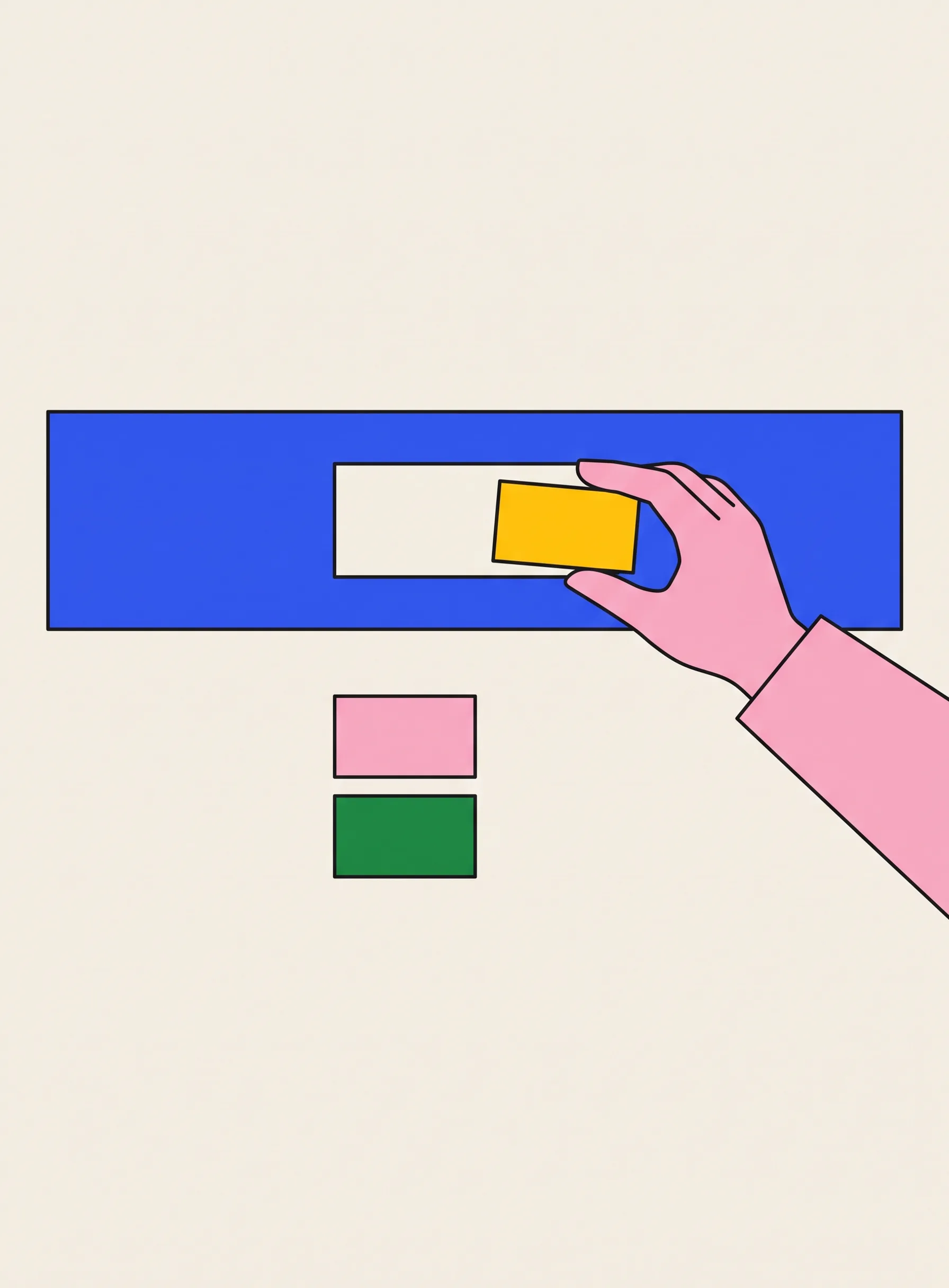
This is the part that most study routines skip, and it is the part that does the work. Split an example sentence into the fixed frame and the slot, and one sentence becomes a family of them.
Take Could I get this without onions?
- Fixed: Could I get this without ___?
- Slot: onions / ice / sugar / cheese / the sauce
You no longer have one sentence about onions. You have every situation in which you want something left out. The same move applies everywhere:
- Let me get back to you on that. → Let me get back to you tomorrow / by Friday / after the meeting.
- Could you walk me through it? → Could you walk me through the process / the numbers / this part again?
- I’m not sure I follow. → I’m not sure I follow the last part.
- How long does it take to get there? → How long does it take to get to the airport / to finish this / to learn?
Do it out loud, five times per frame, with a different word each time. Somewhere around the fifth repetition your attention stops being on the sentence and moves to the blank — and that is exactly the state you need in conversation, where you have time to choose one word and no time to build seven.
One caution: slots are narrower than they look. In It’s been crazy busy lately, swapping crazy for very is fine and swapping it for terribly is not. Vary only the slot you are sure about, and leave the rest of the frame frozen.
Why collected sentences come out wrong
People with hundreds of example sentences and no improvement in speaking usually share the same handful of habits.
- Taking sentences from dictionaries. A dictionary example exists to demonstrate a word’s meaning, not to show how people talk. It has no situation attached, it often leans written rather than spoken, and some entries are decades old.
- Recording the meaning but not the moment. ‘I’m not sure I follow = I don’t understand’ will not come to mind in a meeting. ‘When I lose the thread of an explanation at work’ will.
- Ignoring register. Wanna grab a coffee? and Would you like to get a coffee? mean the same thing and belong in different rooms. Two words in the margin — friend, work — solve this permanently.
- Starting from your own language. Any expression with no equivalent in English gets worse the harder you hunt for the word. Describe the situation instead: if what you mean is that something is more than you are comfortable with, that’s a bit too much for me does the job, and no dictionary was going to hand you that.
- Collecting too much. A notebook with two hundred sentences never gets reopened. A list of ten gets read daily.
If word order or tense is what keeps collapsing rather than the vocabulary, a short pass through English grammar basics before returning to sentences will save you months of rehearsing frames that were broken to begin with.
A one-week routine for ten sentences
The usual failure mode is scaling up. Go the other way. Ten sentences a week is enough, and it compounds to five hundred in a year — more than ordinary conversation needs.
- Monday — choose. Ten sentences you expect to actually need this week, from this list or from a show you watched. Write each in three lines: situation / sentence / my version.
- Tuesday and Wednesday — substitute. Find the slot in each and say five variations out loud. Ten minutes a day covers it.
- Thursday — shuffle. Look only at the situation and produce the English. Anything that takes longer than three seconds is not yours yet; mark it.
- Friday — use them in writing. Three of the ten, in a message, a journal entry or a note to yourself. An English diary fits this step particularly well.
- Weekend — use them on a person. Skip this and the other four days keep only half their value.
The following Monday, delete every sentence that arrived within three seconds and replace it with a new one. The list stays ten items long forever, and the deleted sentences live in your mouth rather than in a notebook.
The last step: saying them to someone
However well organised your sentences are, the final test is the same: the other person says something you did not plan for, your prepared sentence does not quite fit, and you have to use it anyway. Practising alone never trains this, because alone you choose the situation.
Using them for real checks three things at once — whether the sentence is natural, whether the register suits the room, and whether the versions you built out of the frame are actually English. The third one is invisible without a native speaker. Could I get this without onions? is perfect; Could I get this without spicy?, built from the same frame, is not, because an adjective cannot go in that slot. Someone has to tell you that the day you say it.
CoffeeTalk connects you with native speakers for short conversations, and short is an advantage here: deliberately work this week’s ten sentences in, then ask at the end, ‘did any of that sound unnatural?’. You will almost always get one or two corrections, and those two are worth more than the next fifty sentences you would have collected. Setting the topic to daily life or work raises the odds that the situations you prepared for actually come up.
The goal was never a full notebook. It is that every week a few more sentences stop being assembled and start being retrieved. For more raw material, daily English sentences is the natural next list, and how to study English conversation covers holding the whole conversation together once the individual sentences are there.
FAQ
How many English example sentences should I learn per day?
Ten a week is plenty. Twenty a day produces twenty half-memories that surface at the wrong moment. Ten sentences drilled with substitutions and then used on a real person stay. Over a year that is five hundred sentences, which covers most of ordinary conversation.
Are dictionary example sentences good for speaking practice?
Not really. A dictionary example is built to show what a word means, so it carries no situation, often leans written rather than spoken, and sometimes dates back decades. Take sentences from shows, videos, podcasts and real emails instead, and note who said it to whom.
I memorised the sentence but it never comes out in conversation. Why?
Because the meaning was stored and the moment was not. Sentences are triggered by situations, so the situation is what has to be filed: not 'I'm not sure I follow = I don't understand' but 'when I lose the thread of an explanation at work'. A sentence you have never said out loud also almost never arrives.
What is a substitution drill?
Splitting an example sentence into a fixed frame and a variable slot, then saying five versions out loud with a different word in the slot each time. Could I get this without ___? becomes onions, ice, sugar, cheese. Once your attention is on the blank rather than the sentence, the assembly time is gone.
Should I translate expressions from my own language into English?
Only as a last resort, and never word for word. Expressions with no English equivalent get worse the harder you hunt for the matching word. Describe the situation in simple English instead. One easy sentence that works always beats one perfect word that does not exist.