
English learning
How to Write in English Without Translating First
A three-sentence email takes you forty minutes. You write a line, delete it, write it again, and eventually open a translator. Then you look at what the translator produced and still cannot tell whether it is right — whether it sounds stiff, whether it sounds rude, whether a native speaker would ever put it that way. The vocabulary is not the problem. You know every word in the sentence. The sentence just will not assemble.
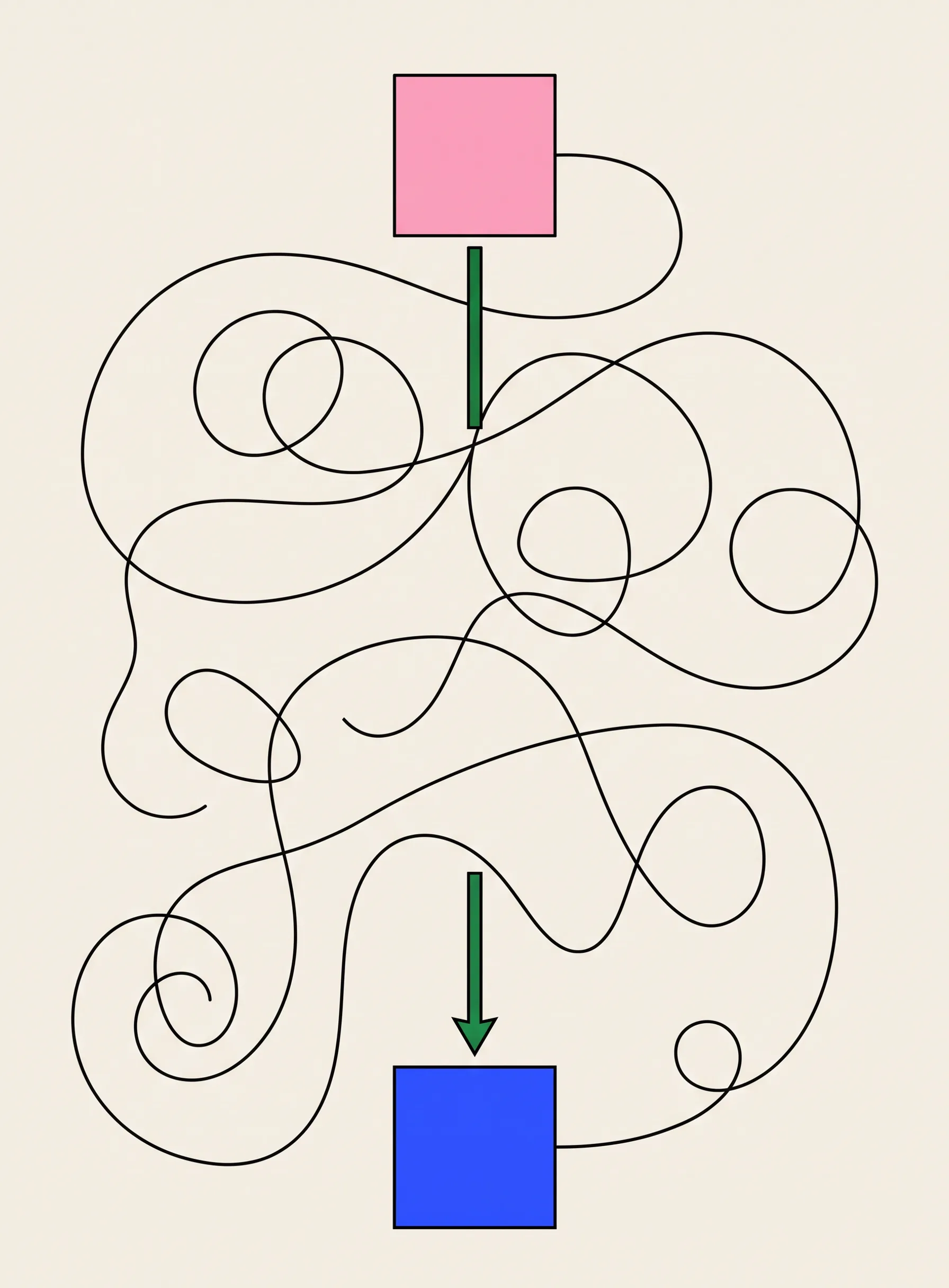
Most advice about how to write in English tells you to read more and build vocabulary. That is not wrong, but it answers a question you are not asking. Your writing stalls because of the order of operations. Nearly everyone composes the sentence in their first language, finishes it, and only then tries to carry it across — but that finished sentence is an object built by the grammar of your language. It may drop its subject, chain four clauses, or load half its meaning onto case endings English does not have. Nothing in English corresponds to it one-to-one. You are not stuck translating; you are stuck trying to translate something untranslatable. This article is about changing the order.
Writing is selection, not translation
What happens in a fluent writer’s head is not translation but selection. They hold a certain number of sentence shapes they can build without thinking, and they choose one. If they own two hundred they choose from two hundred; if they own fifty, from fifty. The crucial part is that they only ever choose from what they already own.
A struggling writer skips that step. They settle on the exact phrasing in their own language, then go hunting for English to match it — which sets up a target their current English cannot reach. So they fail, every time, at a sentence that was never available to them.
Take a real example. You want to say: I looked over the file you sent yesterday, and since the figures on page three don’t match the previous version, I was wondering whether there might be an updated copy somewhere. Carrying that across in one piece needs two subordinate clauses and an embedded question at once, in a second language, under time pressure. That is not a sentence an intermediate writer builds on demand.
But the content is only three pieces. I read the file. Page three looks different. Is there a newer version? As three separate sentences:
- Thanks for sending the file.
- The numbers on page 3 look different from the last version.
- Could you check whether there’s a newer one?
Every one of those is built from grammar you learned in your first two years of English. And here is the part that surprises people: the three-sentence version is closer to how native professionals actually write. Real working email is short and plain. The long, elaborate, maximally polite single sentence is the non-native tell, not the fluent one.
So writing ability is not how many words you know; it is how many sentence shapes you can produce on demand. Growing that inventory is slow work. Re-cutting what you want to say so it fits the inventory you already have is something you can do this afternoon — break the thought up so each piece carries one fact, then attach one short English sentence to each piece. Assembly, not translation.
The four places the handover always breaks
Pushed straight into English, a sentence tends to fail in the same four places regardless of which language you started from. Check only these and you will catch most of what goes wrong.
1. The subject is missing. Plenty of languages — Korean, Japanese, Spanish, Italian, Polish — let you drop the subject when context makes it obvious. English demands one in every finite clause, even an empty one. So writers arrive with that slot unfilled and jam It into it: It was busy, so I couldn’t go. But the thing that was busy was you. After drafting, point at the subject of every sentence. If there is nothing to point at, or It keeps reappearing, that sentence was dragged over from your own language.
2. You never chose a tense. Many languages use one past form where English forces a distinction. I worked there for three years says you have left. I’ve worked here for three years says you are still there. Your own language may let you leave that unspecified; English makes you commit, which means supplying information the original sentence never contained.
3. You converted particles or cases into prepositions. If you learned prepositions as a lookup table — this ending becomes in, that one becomes by — you will be wrong at a steady rate forever, because no such fixed exchange rate exists. That problem needs its own treatment, which is in English prepositions. The one rule worth carrying into your writing: choose the preposition by looking at the verb it attaches to, never by looking at your own language.
4. The sentence never ends. This is the big one. Most languages chain clauses more freely than English does — four linked clauses can sound perfectly elegant in Korean, German, Spanish or Arabic. Chain four in English and the sentence collapses. That is why learner paragraphs are unusually dense with connectives: and, but, so and because turning up three times in one sentence.
One error falls straight out of this, and it is nearly universal among learners whose languages mark a relationship at both ends: Because it rained, so we stayed home. English marks the link once. Either Because it rained, we stayed home or It rained, so we stayed home — never both. Although ~, but ~ is wrong for the same reason.
Read also: How to Write an English Diary That Actually Improves Your Speaking
Short sentences delete half your errors
The fastest improvement available to you is not a grammar course. It is writing shorter sentences. Length multiplies the number of places you can be wrong: add one relative clause and you have simultaneously put the pronoun, the agreement inside it, the tense and the word order at risk. Split that sentence into three and nearly all of those risk points disappear.
A learner explaining a delay produces this:
I attended the meeting yesterday but I couldn’t receive the material before so I couldn’t prepare well and so we postponed the schedule to next week.
Only two things in there are outright errors — couldn’t receive, and so doing duty twice — but the reader still has to go through it twice. Cut into pieces:
I was at yesterday’s meeting. I hadn’t received the materials beforehand, so I wasn’t fully prepared. We’ve moved it to next week.
The errors are gone, and each sentence now has a visible job: the first states a fact, the second gives the reason, the third gives the outcome. Notice too that hadn’t received — a past perfect, supposedly advanced — arrived on its own. In a short sentence you are only tracking one tense, so you have the spare attention to get it right.
Some working rules:
- Keep draft sentences under about fifteen words. Not something to count — just a way of saying that if you cannot read it in one breath, cut it.
- One connective per sentence. If and or but shows up twice, put a full stop where the second one is.
- One fact per sentence. Two facts means two sentences.
- Do not translate your language’s linking particles. Most of them carry no meaning at all; they are just connective tissue. The English equivalent is a full stop.
Do not worry that this will make you look like a beginner. Nearly every English business style guide says the same thing, and long tangled sentences read as disorganised thinking rather than sophistication. To build range at the sentence level rather than the word level, the drills in English example sentences cover exactly that.
Your raw material is chunks, not words
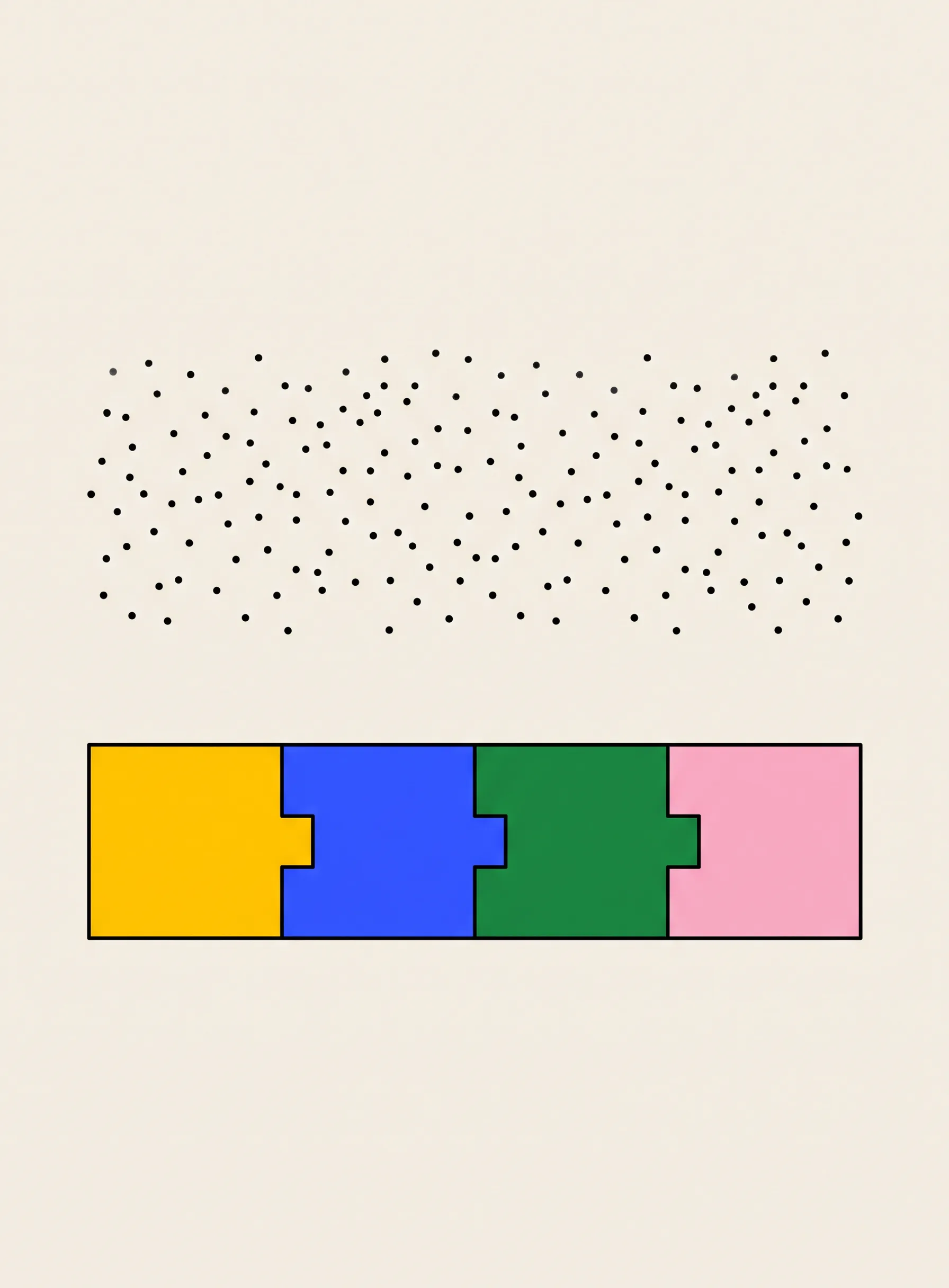
People who have memorised ten thousand words still freeze in front of a blank email, because words are not what sentences are made of. The real raw material is the frame — a sentence shape with a slot in it.
Suppose you want to express uncertainty. Assembling it from individual words produces something like I don’t know well whether..., which is not wrong so much as not English. Own the frame I’m not sure whether ~ and you can fill the slot forever without thinking about it again.
There are far fewer frames than you would expect, because writing asks you to do the same handful of jobs over and over: state an opinion, give a reason, set a condition, compare, request, soften. One reliable frame per job is enough.
- Hedging — I’m not sure whether ~ / It seems that ~ / As far as I know, ~
- Reason — The reason is that ~ / This is mainly because ~
- Condition — It depends on how ~ / If that’s the case, ~
- Clarifying — What I mean is ~ / To be more specific, ~
- Preference — I’d rather ~ than ~ / I’d prefer to ~
- Soft request — Would it be possible to ~? / Could you let me know if ~?
- Ruling out — There’s no need to ~
- Contrast — That said, ~ / Having said that, ~
Those eight will carry something like ninety percent of ordinary email and messaging. Frames also stick far faster than vocabulary does, because each arrives with its use case attached. So in your notes, do not write whether. Write I’m not sure whether it’s a good idea. — the whole thing, ready to lift out.
And the best source of frames is not a textbook. It is the English you receive. Go through emails and messages people have actually sent you, and copy out only the sentences you could not have produced yourself. Those are already fitted to your real situations, which makes them the likeliest to come up again.
The errors that survive everything
The following persist at every level, in writers who read English comfortably and have passed serious exams. They survive because they do not block understanding — nobody corrects them, so they never go away. Search your drafts for them in order.
- 1. Missing articles. The commonest error among speakers of languages without them — Slavic languages, Korean, Japanese, Chinese, Turkish. The category is invisible because your language never asked you to think about it. The rule is narrow enough to apply mechanically: a countable singular noun cannot stand alone. I sent email is wrong; it is an email or the email.
- 2. Missing plural -s. I have two ticket. If your language marks number elsewhere, or optionally, this lasts decades.
- 3. Doubling the connective. Because I was late, so I missed it. Pick one end.
- 4. Too much passive. Usually a carry-over of an impersonal construction: The meeting was decided to be held. Give the sentence a human subject and it fixes itself — We decided to hold the meeting.
- 5. I think everywhere. Three times in a paragraph that was obviously your opinion anyway. Delete them and the writing gets firmer.
- 6. almost misused. almost people is not possible — it is most people or almost all people. almost cannot modify a noun directly.
- 7. -ed versus -ing. I’m boring means you are the cause; I’m bored is what you meant. Same for interested/interesting, confused/confusing.
- 8. Extra prepositions on time words. in last week, on next Monday. With last, next, this and every, English drops it entirely.
- 9. Adverb placement. I yesterday went there follows your word order, not English’s. Time expressions belong at the front or the end.
- 10. Over-politeness. Stacking every courtesy marker you know: I would like to kindly ask you to please check ~. English signals politeness structurally. Could you check ~? is already polite.
The first two will not yield to understanding, because there is nothing to understand — they need the mechanical pass covered in the next section. For the underlying rules in compact form, English grammar basics keeps only what matters for communication.
Five passes over the draft
People who write well in a second language are not people who get it right the first time. They draft fast and go over it several times, looking for exactly one thing per pass. Trying to see everything at once means seeing nothing.
Pass 1 — length. Hunt only for long sentences. Any sentence you cannot read in one breath gets a full stop added; any sentence with two or more connectives gets split. This pass alone does more than the other four combined.
Pass 2 — subjects and verbs. Point at the subject of every sentence. Supply it where it is missing; replace repeated It with a person or a concrete thing. Then check each verb for one decision only: finished, or still going on?
Pass 3 — nouns. Look at nothing but the nouns. For each one, decide: a, the, or plural. It is tedious, and it is the highest-yield pass if your first language has no articles.
Pass 4 — deletion. Find I think, very, really, actually and kindly, and cut most of them. Turn passives active. The text usually loses a fifth of its length and gains most of its clarity here.
Pass 5 — read it aloud. Reading silently is useless; your brain repairs the text as it goes. Your mouth does not — it stumbles exactly where the sentence is wrong. Mark the stumbles and fix them. This pass is also where writing starts feeding your speaking.
One more check you can run alone: back-translation. Put your finished English into a translator and read it in your own language. If what comes back is not what you meant, the sentence is broken. Asking a translator to produce English teaches you nothing, because you keep receiving sentences you could not have built; using it to inspect your own English is a surprisingly accurate mirror.
There is one category these five passes will never catch: sentences that are perfectly correct and that nobody says. I will do my best to improve my English ability breaks no rule and no native speaker would write it. No checklist finds that. Only a reader can.
How to turn writing into speaking
The real payoff of writing is not the writing. It is that writing is speaking in slow motion. In conversation you have about two seconds to build a sentence — not enough time to notice what you cannot build. On the page the clock stops, and every gap becomes visible and addressable. Writing is where you draw the blueprint that speaking later executes.
To make that transfer actually happen:
1. Read everything you write out loud. Written and left there, it stays in your hands and never reaches your mouth. Read a sentence three times and its shape moves into the pile you can reach for while talking.
2. Frequency beats volume. Three sentences every day will take you further than five hundred words every Saturday. For that built into a daily habit, how to write an English diary lays out a thirty-day routine.
3. Write the same thing twice. Tomorrow, rewrite today’s three sentences without looking. Whatever you stall on is precisely your weak point, and it shows up immediately. This repetition is worth more than constantly starting new topics.
4. Then get it read by a person. Skip this and the other three lose half their value. Missing articles and technically-correct-but-nobody-says-that sentences are invisible from the inside, because both communicate fine. On CoffeeTalk you can send a partner a few sentences and ask them to mark only what sounds unnatural, rather than everything that is wrong. Narrowing the request makes it easy to answer honestly, and a pattern someone flags usually disappears the second time you hit it.
One closing adjustment to your target. The goal is not an error-free text. It is a text your reader understands on the first pass. An email of five short sentences with one missing article does its job completely; one long, immaculate sentence makes the reader go back to the start. Raise clarity before accuracy — and clarity improves today, for free, the moment you start cutting sentences in half.
FAQ
Why is writing in English so hard when I already know the words?
Because the order is backwards. Most people finish the sentence in their first language and then try to carry it across. But that finished sentence is built by your language’s grammar — it may drop the subject, chain several clauses, or lean on case endings English does not have — so no English sentence matches it one-to-one. The fix is not more English, it is breaking the thought into pieces first. Split what you want to say so each piece holds one fact, then attach one short English sentence to each. Most of it then fits inside grammar you already know.
Is it bad to use a translator when I write in English?
It depends which direction you use it in. Asking it to produce English for you teaches you nothing, because you keep receiving sentences you could not have built yourself, so your usable range never grows. Using it to check English you already wrote is genuinely useful: put your own sentence in, read it back in your language, and if what comes back is not what you meant, the sentence is broken. Draft it yourself, then use the translator only as a mirror.
What is the single most common mistake in non-native English writing?
Articles, followed closely by plural -s. If your first language has no articles — Slavic languages, Korean, Japanese, Chinese, Turkish — the category is simply invisible, and because the errors never block understanding, nobody corrects them. Remember one narrow rule: a countable singular noun cannot stand alone without a or the. Then add a dedicated editing pass where you look at nothing but the nouns and decide a, the, or plural for each one. A mechanical pass works better than restudying the grammar.
Won’t short sentences make my English look basic?
No — the opposite. Almost every English business style guide recommends short sentences, and long tangled ones read as disorganised thinking rather than as skill. Length also multiplies risk: one relative clause puts the pronoun, the agreement, the tense and the word order in play simultaneously. Keep draft sentences to about fifteen words and one connective each. The same content split into three sentences has fewer errors and lands with the reader on the first read.
How much should I write each day to improve?
Frequency matters far more than volume. Three sentences daily beats five hundred words once a week. Always read what you wrote out loud three times — otherwise it stays in your hands and never reaches your mouth. Add one repetition: rewrite the same few sentences the next day without looking, which exposes exactly where you get stuck. And have a person read at least some of it, asking them to mark only what sounds unnatural. The errors that communicate fine are the ones you will never catch alone.