
Korean culture
Korean Slang: 40 Words K-drama Fans Actually Hear

You are two episodes into a new drama when a character throws her head back and shouts something the subtitles render as Oh my god! The word was 대박. Three scenes later a friend mutters 헐 and the subtitle says What? Then a text flashes across the screen — ㅋㅋㅋㅋ, ㅇㅈ, ㄹㅇ — and the subtitle does not even try.
Korean slang is where the distance between the Korean in your textbook and the Korean people actually speak opens widest. Textbooks teach 재미있어요; a twenty-three-year-old says 꿀잼. And unlike grammar, slang has a shelf life — a word that made you sound current in 2019 can make you sound like someone’s uncle in 2026. What follows is the slang that genuinely repeats: the drama vocabulary, the consonant shorthand that fills Korean group chats, how a new Korean word gets built out of four syllables, which words have already expired, and where using slang will land you in trouble.
Why Korean slang moves faster than you can learn it
Korean produces new words at a rate that surprises people coming from English, and it is not an accident. Three mechanisms do most of the work, and once you can see them you can usually decode a word you have never met.
- Clipping (줄임말). Take the first syllable of each word in a phrase and glue them together. 아이스 아메리카노 becomes 아아. 치킨 plus 맥주 becomes 치맥. Four syllables in, one new word out.
- Initial consonants (초성). Korean letters sit in syllable blocks, so you can strip a word down to its leading consonants and it stays readable. 감사 becomes ㄱㅅ. This one has no real English equivalent, and it is why Korean chat looks like static to a learner.
- Borrow and bend. English words come in and get reshaped until they are no longer English: 어그로 from aggro, 셀카 from self camera, 킹받다 from king fused onto 열받다.
The second reason is structural. South Korea is a small, dense, intensely online country with one dominant messaging app and a media industry that recycles whatever is trending within weeks. A word can travel from one streamer to a national variety show in a month. The National Institute of Korean Language publishes an annual list of new coinages, and the striking thing about those lists is the attrition: a large share of each year’s entries are unrecognisable three years later.
One distinction to get straight before anything else. 신조어 and 유행어 — coinages and buzzwords — are what this article is about, and they are not inherently rude. 비속어, actual vulgar language, is a separate category with separate consequences; our guide to Korean swear words covers that side, including the words that sit awkwardly between the two.
The slang you hear in every drama
These are the words that survive. Most have been in circulation for a decade or more, which is exactly why they turn up in drama after drama, and why they are safe for a learner to actually use.
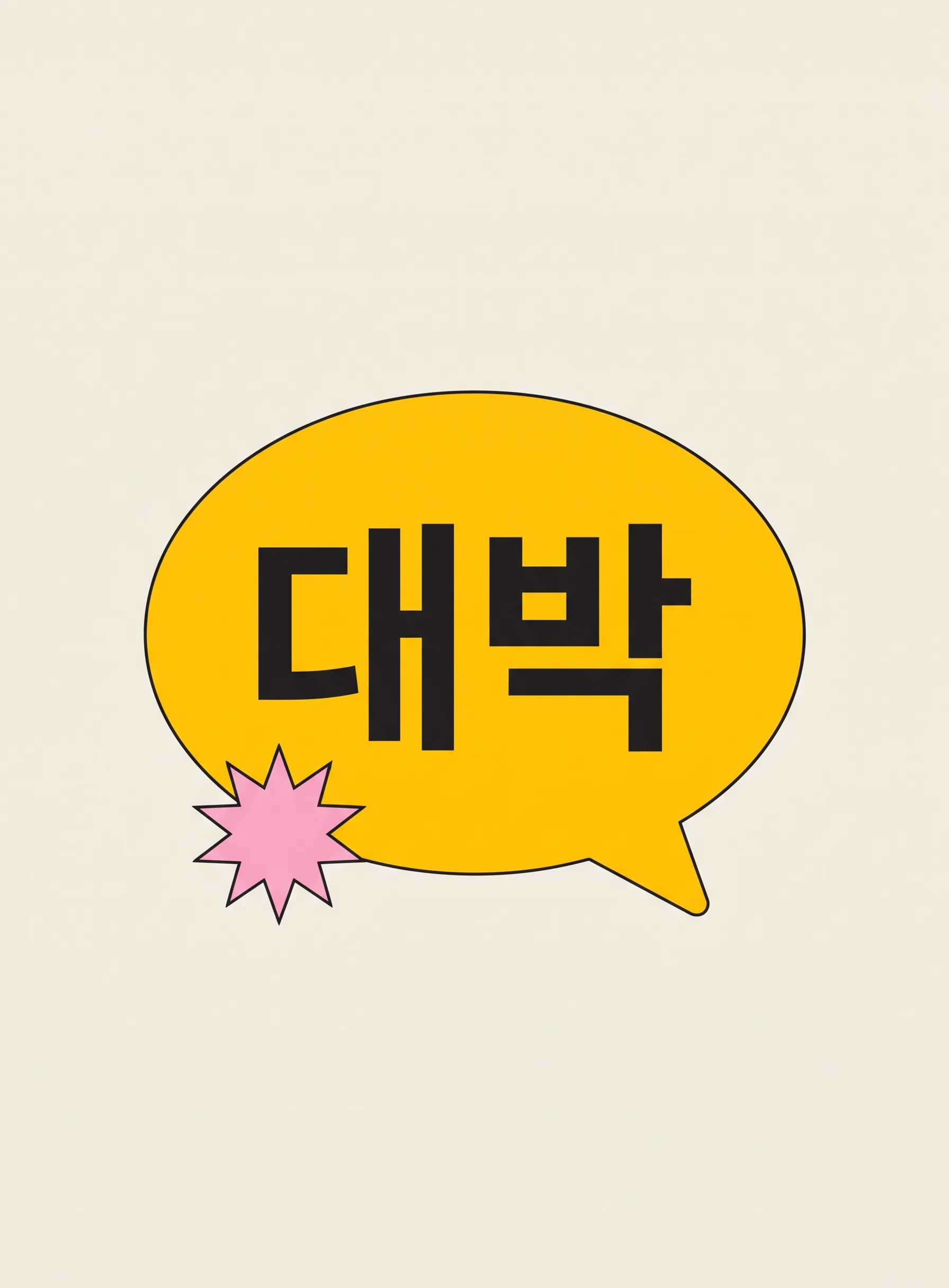
- 대박 — literally jackpot. The all-purpose exclamation for anything astonishing, good or bad: a promotion, a plot twist, a bill that came to twice what you expected. It works alone as a complete sentence.
- 헐 — the noise of disbelief. Closer to wait, what than to wow, and it carries a small negative tilt.
- 미쳤다 — it is crazy. Now mostly a compliment: 이거 미쳤다 means this is insane, in a good way.
- 진짜 / 레알 — seriously? 진짜 is the normal word and never goes out of style. 레알, imported from Spanish by way of football, is dated.
- 꿀잼 / 노잼 — honey plus fun, and no plus fun. Hilarious, and not funny at all. 노잼 is the more useful of the two because it has no polite equivalent.
- 핵- — nuclear, an intensifier bolted onto the front of almost anything: 핵꿀잼, 핵노답.
- 멘붕 — 멘탈 붕괴, mental collapse. The feeling after an exam goes badly.
- 현타 — 현실 자각 타임, reality-recognition time. The moment the fun stops and you see what you are actually doing. There is no one-word English equivalent, which is part of why it spread.
- 노답 — no answer. Hopeless, beyond help. Applied to a person, it stings.
- 썸 / 썸타다 — from English something. The undefined stage before dating. Half of romantic-comedy plotting happens inside this word.
- 밀당 — 밀고 당기기, push and pull. Deliberate hot-and-cold behaviour in early dating.
- 금수저 / 흙수저 — gold spoon and dirt spoon. Born rich, and born with nothing. The spoon vocabulary runs through an enormous amount of recent Korean drama.
- 갑질 — abuse of power by whoever holds the stronger position, from 갑, the ‘party A’ of a contract. A chaebol heir screaming at staff is 갑질, and the word carries real anger.
If you only ever learn three, make them 대박, 헐 and 진짜. They are reactions rather than statements, which means you can drop them into a conversation without having to build a sentence around them first.
Read also: How to Say Thank You in Korean (Formal, Casual and In Between)
Chat slang: Korean written without its vowels
Open any Korean group chat and the first thing you see is lines made of consonants. This is 초성체, initial-consonant writing, and it is the highest-frequency slang system in the language.
The logic is simple once stated. Every Korean syllable block begins with a consonant, so you can keep the leading consonants and throw the rest away: 감사 keeps ㄱ and ㅅ and becomes ㄱㅅ. Nothing here is pronounced; these are written forms only.
- ㅋㅋㅋ — laughter, from 크크크. The workhorse. ㅎㅎ (흐흐) is softer and warmer, closer to a smile than a laugh.
- ㅠㅠ / ㅜㅜ — crying eyes. Used for genuine upset and for mock misery in equal measure.
- ㅇㅇ — 응응, yeah. ㄴㄴ — no no. ㅇㅋ — okay.
- ㄱㅅ 감사, thanks · ㅈㅅ 죄송, sorry · ㅊㅋ 축하, congratulations · ㅂㅂ 바이바이 · ㅅㄱ 수고, good work.
- ㅇㅈ — 인정, agreed, that is a fact. ㄹㅇ — 리얼, for real. These two are the backbone of agreeing with somebody online.
- ㅁㅊ — 미친, used as an intensifier the way English uses a stronger word.
- ㅈㄱㄴ — 제목이 곧 내용, the title is the content, posted when a forum title already said everything.
Two things learners consistently miss. First, the number of ㅋ is the tone. A single ㅋ reads as cold, even hostile — the text equivalent of a flat stare. ㅋㅋ is neutral acknowledgement. ㅋㅋㅋㅋㅋ is actual laughter. Matching your partner’s ㅋ count is a real social skill, and sending one ㅋ to someone who sent you five is a small insult you will deliver entirely by accident.
Second, this is written register, not spoken. Nobody says ㄱㅅ out loud. The one that crossed over is ㅋㅋ, which you will occasionally hear pronounced as a joke.
Four syllables, one new word
The clipping habit deserves its own section, because once you can run it backwards you can decode words nobody has taught you. Say the pieces slowly and the original phrase usually falls out.
- 아아 — 아이스 아메리카노. Iced americano, ordered year-round, famously including in February.
- 치맥 — 치킨 and 맥주. Fried chicken and beer, an institution rather than a meal. 소맥 is 소주 and 맥주 mixed.
- 혼밥 / 혼술 — 혼자 밥, 혼자 술. Eating and drinking alone, a real cultural shift that needed a word.
- 불금 — 불타는 금요일, burning Friday. Friday night.
- 열공 — 열심히 공부. Studying hard; 열공해! is a standard send-off before an exam.
- 꾸안꾸 — 꾸민 듯 안 꾸민 듯, styled as though not styled. Effortless-looking effort, compressed to three syllables.
- 갑분싸 — 갑자기 분위기 싸해짐. The mood suddenly going cold after somebody says the wrong thing.
- 안물안궁 — 안 물어봤고 안 궁금해. Didn’t ask, don’t care. Blunt, and meant to be.
- 인싸 / 아싸 — insider and outsider, from the English words. 핵인싸 is the person at the centre of every room.
- 최애 — your absolute favourite, usually a group member; 차애 is your second. 비담 is 비주얼 담당, the member who handles the looks. This vocabulary is fandom-native and sits alongside terms like maknae that fans use constantly.
- 어그로 — from gaming aggro. 어그로 끌다 is to court attention by being inflammatory.
- 엄친아 — 엄마 친구 아들, mum’s friend’s son. The impossibly accomplished person your mother keeps comparing you to. Understood everywhere, though it peaked years ago.
There is one more layer, called 야민정음 after 훈민정음, the original name of the alphabet. It swaps letters that look similar rather than ones that sound similar: 멍멍이 becomes 댕댕이, 명곡 becomes 띵곡, 귀여워 becomes 커여워. It is a purely visual joke, impossible to hear, and completely opaque until somebody explains it to you.
The slang that dates you
This is the part no word list tells you. Korean slang expires, and using an expired word is not neutral — it places you, precisely, in a decade.
Long dead. 짱, meaning the best, was everywhere in the late 1990s and 2000s and now reads as distinctly middle-aged; 최고 or 미쳤다 do the job instead. 솔까말 (솔직히 까고 말해서, honestly speaking), 레알, 지못미 and the 캐- intensifier of 캐좋아 all belong in the same museum.
Fading. 갑분싸 and 인싸/아싸 arrived around 2018 and had an enormous run. They are still understood instantly and still used, but they no longer sound new.
Recent, and already uneven. 킹받다 — king fused onto 열받다, meaning infuriating in a comic way — came out of streaming culture around 2021 and has held up well. 어쩔티비, roughly whatever, go watch TV, burned through middle schools in the same period and died so thoroughly that using it now is itself the joke. 뇌절, labouring a joke long past the point anyone found it funny, is holding.
Three practical rules fall out of this:
- Reaction words outlive descriptive ones. 대박, 헐, 진짜 and 미쳤다 have been stable for twenty years. Anything built out of a specific meme has a half-life measured in months.
- If you learned it from a list, check the date. A great deal of the Korean slang content online was written around 2016 and has simply been copied forward ever since.
- Date what you collect. Note where and when you heard a word, and who said it. A word from a 2015 drama and a word from a video posted last week are not the same kind of object.

Where slang gets you into trouble
Slang in Korean is not only informal, it is a claim about the relationship between you and the person you are speaking to. That is the part that catches learners out.
Korean forces a speech level on every sentence — 존댓말 or 반말, with no neutral middle — and slang sits firmly on the casual side. Bolting it onto a polite ending produces a sentence that fights itself: 그거 핵꿀잼이었습니다 is grammatically fine and socially bizarre, something like that was absolutely sick, sir. Our guide to Korean honorifics sets out the levels properly, and it is worth reading before you start experimenting, because slang amplifies every mistake you make there.
Four specific hazards:
- Anyone above you. A 선배, a manager, a teacher, a friend’s parent. The line is not age alone but rank, and slang with someone senior reads as presumption rather than friendliness.
- The 개- and 존- intensifiers. 개좋아 and 존맛 are everywhere among young people, and both come from coarse roots — 개 as a prefix is rude, and 존맛 is a clipped form of a genuinely vulgar phrase. Koreans in their twenties use them freely with each other and would not use them in front of a manager. As a learner you get less latitude than a native speaker does, because nobody can tell whether you know what you are saying.
- Written contexts. 초성체 in an email, a message to a professor, or anything resembling work is a mistake. It belongs to friends and group chats, full stop.
- Subtitles flatten everything. Streaming subtitles render 헐, 대박, 미쳤다 and several genuinely vulgar words as the same handful of English exclamations, so the register information never reaches you. Learning slang from subtitles alone teaches you what words mean without teaching you what they cost.
The safe default is simple: let the other person set the level. If they are speaking 반말 and using slang with you, you can follow. Until then, don’t.
How to actually start using Korean slang
Recognising slang and producing it are different skills, and most learners only ever build the first. You can understand 꿀잼 perfectly well and still never say it, because the word that arrives when you open your mouth is the textbook one. Closing that gap takes a particular kind of practice.
- Start with five reaction words, not forty. 대박, 헐, 진짜?, 미쳤다, ㅋㅋㅋ. They need no grammar around them, they fit anywhere, and they are what a conversation actually demands in real time.
- Mirror, do not lead. Use a word after your partner has used it. That solves register, currency and appropriateness in one move, and it is what everybody does in their own language without noticing.
- Mine one drama properly instead of ten lists. Watch a scene twice, once with subtitles and once without, and write down the short reactions rather than the long lines. Note who said it to whom: the same word between friends and from a junior to a senior are two different facts.
- Keep a dated list. Word, where you heard it, who said it, and the date. Three months on you can see which words keep reappearing and which you only ever saw once.
- Say it to a person. Slang is calibration, and calibration needs a reaction. You cannot tell from a textbook whether your 헐 landed as amused or as rude.
That last step is the only one that cannot be faked, and it is the one most learners skip. On CoffeeTalk you can put a handful of these words in front of a native speaker and find out in ten minutes what a year of watching dramas will not tell you: whether 대박 came out at the right moment, whether your ㅋ count matched theirs, and which of the words you collected they genuinely have not heard since school. That feedback is the whole game. Slang is the one part of a language where being approximately right is worse than not trying, and the fastest route to getting it right is being told, kindly, by somebody who uses it every day.

FAQ
What is the most common Korean slang word?
대박. It literally means jackpot and works as an all-purpose exclamation for anything surprising, good or bad, from a promotion to a plot twist to a bill that came to twice what you expected. It stands alone as a complete sentence, which is why it survives decade after decade while most slang expires. 헐 and 진짜 are close behind for the same reason: they are reactions rather than statements, so they need no grammar around them.
What does ㅋㅋㅋ mean in Korean?
It is laughter, written with the initial consonant of 크크크, and it is never spoken aloud. The detail that matters is the count. A single ㅋ reads as cold or dismissive, ㅋㅋ is neutral acknowledgement, and ㅋㅋㅋㅋㅋ is real laughter. Replying with one ㅋ to somebody who sent five is a small insult most learners deliver by accident. ㅎㅎ is the softer, warmer version, closer to a smile than a laugh.
Is it rude to use Korean slang?
Not in itself, but it is a claim about the relationship. Korean makes you pick a speech level in every sentence and slang sits on the casual side, so using it with a 선배, a manager or anyone clearly senior reads as presumption rather than friendliness. The 개- and 존- intensifiers are a separate problem, since both come from coarse roots. The safe rule is to mirror: use a word only after your conversation partner has used it with you.
What does 헐 mean?
It is the sound of disbelief, roughly wait, what. Subtitles usually render it as oh my god or seriously, but 헐 carries a slight negative tilt that those translations lose. Use it for bad news, awkward revelations and things that are surprising in an uncomfortable way. For straightforwardly good surprises, 대박 is the better choice.
Is 짱 still used in Korean?
Rarely, and it dates you. 짱 meaning the best was everywhere in the late 1990s and 2000s and now sounds distinctly middle-aged to a Korean in their twenties. 최고 is the neutral word, and 미쳤다 is what younger speakers reach for when something is outstanding. A great deal of the Korean slang content online was written years ago and copied forward since, which is how 짱 keeps turning up on lists of current slang.