
Korean culture
What Does Jagiya (자기야) Mean? Korean Terms of Endearment, Explained
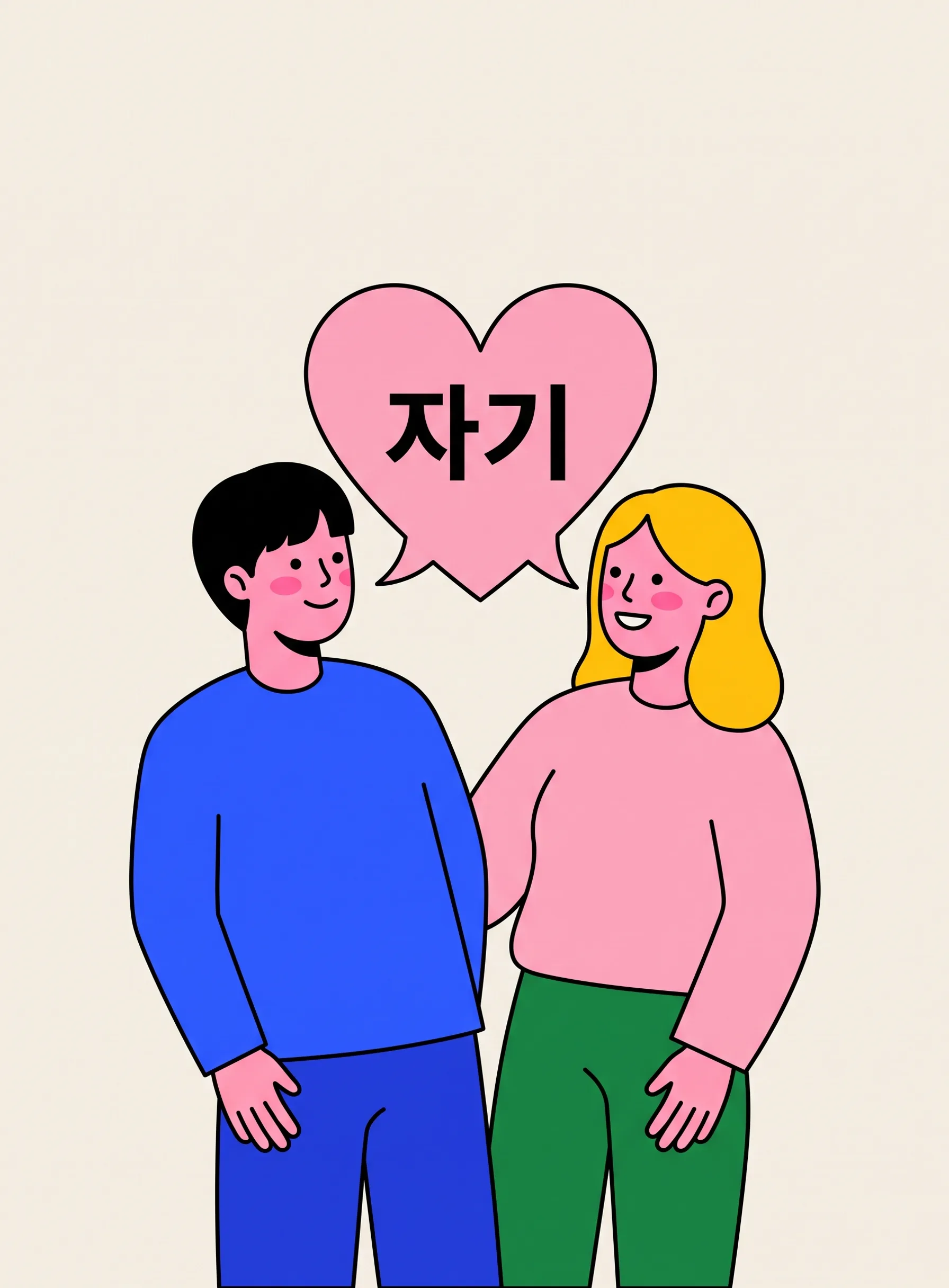
If you have watched more than two Korean dramas, you have heard it. One character leans in, drops their voice, and says 자기야. The subtitles render it as “honey”, “babe” or “darling”, and you move on. But the jagiya meaning is stranger than any of those translations suggest: the word literally means oneself. Korean couples are, quite literally, calling each other ‘self’.
That gap between the dictionary and the drama is where most learners get into trouble. 자기야 is warm, extremely common, and also carries rules about who may say it to whom — rules that, if you break them, take you from charming to creepy in one syllable. This guide covers what 자기 actually means, why the 야 is there, how it sits against 여보, 오빠 and the rest of the Korean pet-name shelf, where Koreans use it outside romance, and the mistakes that give a learner away.
What 자기 actually means
Start with the grammar, because it explains everything that follows. 자기 (jagi) is a reflexive pronoun meaning oneself, one’s own. It is a perfectly ordinary, unromantic word that appears in sentences like 그는 자기 차를 팔았어요 (‘he sold his own car’) or 자기 일은 자기가 해야죠 (‘you should do your own work’). The most familiar example for any learner is 자기소개 — self-introduction, the first thing you are asked to do in a Korean classroom.
So how did ‘self’ become ‘darling’? Through the same logic that gives English my other half and my better half. Calling your partner 자기 says: you are not a separate person to me, you are me. It is the most intimate available claim, dressed up as a pronoun. Korean does something similar with 우리 (‘our’) — 우리 남편, ‘our husband’, for a woman’s own husband — where the possessive dissolves a boundary rather than drawing one.
The practical consequence is that 자기 in a couple’s speech works as a second-person pronoun, not just a nickname. This is genuinely useful, because Korean famously avoids saying ‘you’: 너 is for friends and juniors, 당신 sounds confrontational in most contexts. Couples solve the problem by using 자기 where English would use ‘you’. 자기 어디야? is ‘where are you, babe?’ 자기 뭐 먹고 싶어? is ‘what do you want to eat?’ The word fills a hole in the pronoun system, which is a large part of why it is so heavily used.

자기 or 자기야? Why the 야 is there
Learners often treat 자기 and 자기야 as two separate words. They are one word with and without a vocative particle — the little ending Korean attaches when you call out to someone. The rule is mechanical: 야 after a vowel, 아 after a consonant. 민지 → 민지야, 민준 → 민준아. 자기 ends in a vowel, so it is always 자기야, never 자기아.
Which form you use depends on where the word sits in the sentence:
- 자기야 when you are calling someone or getting their attention. 자기야, 이것 좀 봐 — ‘babe, look at this.’ Standing alone as a summons across a room, it is always 자기야.
- 자기 when the word is doing a grammatical job inside the sentence. 자기 언제 와? (‘when are you coming?’), 자기가 골라 (‘you pick’), 자기한테 줄게 (‘I’ll give it to you’). Here it takes normal particles — 가, 는, 한테 — like any other noun.
You will also meet 자기야~ with a long drawn-out vowel, which is pure aegyo — the cute, wheedling register Koreans use when asking for something. The elongation is doing the work, not the word.
On romanisation: you will see jagiya, jagi-ya and the older chagiya. The initial ㅈ sits somewhere between English j and ch and is unaspirated, which is why both spellings survive. Say it as two even syllables, ja-gi, with no stress on either — Korean does not stress syllables the way English does, and an English-style JAH-gee-yah is one of the quickest ways to sound foreign.
The rest of the pet-name shelf: 여보, 오빠, 애기야
자기야 is the most flexible term of endearment in Korean, but it is not the only one, and the others are not interchangeable. Each carries information about the stage of the relationship.
- 여보 (yeobo) — for married couples. It is a contraction of 여기 보오, roughly ‘look here’, and it sounds settled, domestic, slightly older. A dating couple who use 여보 are either joking or making a point. Its partner-word is 당신, which is a normal, affectionate ‘you’ between spouses even though it sounds aggressive with anyone else.
- 오빠 (oppa) — used by a woman for an older man, including her boyfriend. Crucially it is not only romantic; it is also what you call an older brother or an older male friend. The romance is in the delivery, not the word. We covered the full range in what oppa means.
- 애기야 (aegiya) — literally ‘baby’. Sweeter and more childlike than 자기야, and noticeably more common on television than in life. Some couples love it; plenty of Koreans find it too much.
- 내 사랑 (nae sarang) — ‘my love’. Real, but written: song lyrics, letters, captions. It is not what anyone calls out from the kitchen.
- Loanwords — 허니, 달링, 베이비. Used lightly and a little ironically, the way an English speaker might drop in mon chéri.
- The name plus 아/야 — the quiet workhorse. Many Korean couples simply use each other’s given name with the vocative particle, and among younger couples this is more common than any pet name at all.
There is a rough progression here. Early dating tends toward the name, 오빠 or 씨; a few months in, 자기야 appears; after marriage 여보 arrives and often coexists with 자기야 for years. Moving too fast up that ladder is exactly the mistake foreigners make.
Where you hear 자기 outside romance
This is the part no drama will teach you, and the part most likely to confuse you in Seoul. 자기 escapes the couple and turns up in places that have nothing to do with love.
In shops and salons. An older woman running a clothing shop, a hairdresser, a market stall owner or a gym instructor may call a younger female customer 자기. It is meant as friendly and familiar — the same warm-bossy register as English love, hon or sweetheart from a waitress. Some Koreans find it endearing, others find it presumptuous. Either way, you are not being flirted with.
Between close female friends. Used jokingly, often with exaggerated 애교, in the same spirit as calling a friend darling in English.
At work — and this is the one to know about. An older colleague or manager calling a junior 자기, particularly a man to a younger woman, reads today as inappropriate. It was ordinary a generation ago and is now widely treated as exactly the kind of overfamiliarity that turns up in workplace-harassment training. If you are a learner working in Korea, do not use 자기 with a colleague. There is no version of it that sounds professional.
The pattern underneath all of these is that 자기 claims closeness. Between two people who agree they are close, that claim is affectionate. Imposed downward by someone senior, it is a small act of taking a liberty. Hearing the difference is the actual skill.
자기야 in K-dramas and K-pop
Because so much of a learner’s Korean arrives through a screen, it is worth knowing how television distorts the word.
Dramas use 자기야 as shorthand for a change in relationship status. The moment a character switches from someone’s name to 자기야 is a plot beat — the same signal as the moment they drop from 해요체 into 반말. Writers use it deliberately, which means it appears far more often, and far more suddenly, than in life. A drama couple may reach 자기야 in three episodes; a real couple more often takes months.
Television also loads the word with tone. Said flatly at the start of a sentence — 자기야. 우리 얘기 좀 해 — it announces a serious conversation, exactly like an English speaker using your full name. Stretched and rising, 자기야~, it is a request for something. The same two syllables carry both, and the difference is entirely in the melody. This is worth listening for on purpose: pick any romance drama, note every 자기야 in one episode, and mark whether it was asking, warning or just calling. You will learn more about Korean intonation in twenty minutes than from any explanation.
K-pop leans the other way. Lyrics prefer 그대 — a poetic, slightly archaic ‘you’ that almost nobody says out loud — along with 내 사랑 and plain 너. Learn your terms of endearment from lyrics and you will end up with a beautiful vocabulary that sounds like a greeting card when spoken.

Mistakes learners make with 자기야
Most of these come from treating 자기야 as a neutral friendly word rather than a claim about a relationship.
- Using it too early. The single most common error. 자기야 says we are a couple and we both know it. Said to someone you have been on two dates with, it is not bold, it is presumptuous. Use their name with 씨 or 아/야 until they reach for a pet name first.
- Using it with a friend. Between an older Korean woman and a younger one it can pass. From a foreign learner to a Korean friend, it lands as a clumsy pass.
- Using it at work. Covered above, and worth repeating: never.
- Assuming it is gendered. It is not. Both partners use 자기야 to each other, unlike 오빠 or 누나, which are asymmetric by definition.
- Writing 자기아. The particle is 야 after a vowel. 자기아 does not exist.
- Panicking at the reflexive 자기. When you read 자기 방 or 자기 생각 in a textbook, it means ‘one’s own room’ and ‘one’s own thoughts’. Nobody is being called darling.
- Translating ‘my love’ literally in speech. 내 사랑 is written Korean. Said to someone’s face, it sounds like a subtitle.
- Mixing 자기야 with formal endings. 자기야, 어디 가십니까? is a joke sentence. Pet names live in 반말; if you are using 자기야, the rest of the sentence should be casual too.
How to actually use Korean terms of endearment
The grammar of 자기야 takes one minute to learn. The timing takes much longer, because it is a social judgement rather than a rule — and no amount of reading gives you that judgement.
- Follow, do not lead. The reliable strategy in any language you are learning: let the native speaker set the level of intimacy, then match it. If they call you 자기야, you may call them 자기야. Until then, use their name.
- Learn the vocative particle properly. 아 after a consonant, 야 after a vowel. It applies to every Korean name you will ever call out, not only to pet names, and getting it wrong is audible immediately.
- Practise the intonation, not just the word. Say 자기야 three ways — calling across a room, asking for a favour, opening a serious sentence. Record yourself. The melody is the meaning.
- Notice it in the wild. Every time you hear 자기 in a drama, a variety show or a shop, ask who is saying it to whom. The pattern of permissions becomes obvious after about twenty examples.
And then say it to a person, because affectionate language is the hardest kind to learn alone. A textbook will tell you 자기야 means ‘honey’; it will not tell you that your delivery made it sound sarcastic, or that a Korean in their twenties would have used the name instead. CoffeeTalk pairs you with native Korean speakers for short conversations, and this is an unusually good topic to bring — ask your partner what their friends actually call their partners, and you will get ten minutes of honest, current, unteachable detail. Choosing topics like family, dating or television makes these words show up on their own.
For the words that sit next to this one, see 오빠, 누나 and 형, or start with how to say I love you in Korean.

FAQ
What does jagiya (자기야) mean in Korean?
자기야 is a term of endearment used between Korean couples, roughly equivalent to honey, babe or darling. The root word 자기 literally means 'oneself', and 야 is the vocative particle Korean adds when calling someone whose name ends in a vowel.
What is the difference between 자기 and 자기야?
They are the same word. 자기야 is the calling form, used when you address or summon your partner. 자기 is used inside a sentence with normal particles, where it works like the pronoun 'you' — 자기 어디야? means 'where are you, babe?'
Is 자기야 only used by couples?
Mostly, but not entirely. Older women in shops and salons sometimes call younger female customers 자기 as a friendly, familiar form of address, and close female friends use it jokingly. Used by a senior colleague toward a junior at work, it is considered inappropriate today.
What is the difference between 자기야 and 여보?
여보 is for married couples and sounds settled and domestic; it comes from 여기 보오, 'look here'. 자기야 works for dating and married couples alike and sounds younger and more affectionate. Many married Koreans use both.
When can I start calling someone 자기야?
Once you are clearly a couple and they have used a pet name for you first. 자기야 announces an established relationship, so using it after a couple of dates sounds presumptuous. Until then, use their given name with 씨 or the vocative 아/야.