
Korean culture
What Does Unnie (언니) Mean? The Korean Word Only Women Get to Say
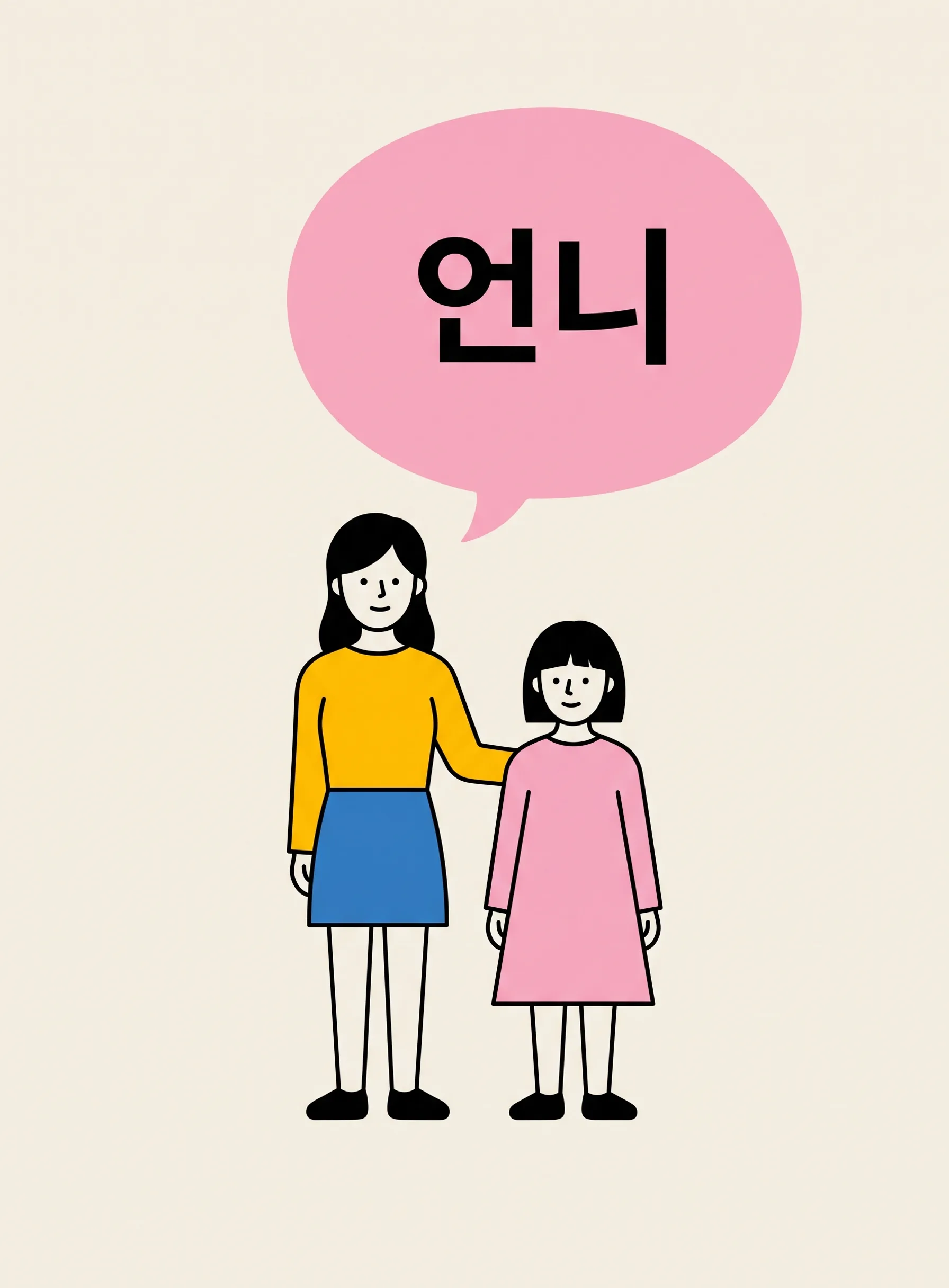
You have heard it in every drama with more than two female characters. One woman turns to another and calls her 언니, and the subtitle renders it as ‘sis’, or swaps in a name, or quietly drops it. So what does unnie mean? The short answer is ‘older sister’. The useful answer is that 언니 is a word you are only permitted to say if you are a woman, and that most of the people a Korean woman calls 언니 are not her sister and never will be.
That is the part a subtitle cannot carry. Korean kinship words encode two things at once — who the other person is, and who you are — and 언니 is the cleanest example of it in the language. This guide covers what 언니 literally means, the four-word grid it belongs to, where Koreans use it far outside the family, how K-pop fandom stretched it, and the mistakes that identify a learner in one syllable.
What 언니 actually means
언니 is the word a female speaker uses for an older female. Romanised officially as eonni and almost everywhere else as unnie, it starts with a biological older sister and radiates outward from there — to cousins, school seniors, colleagues, friends of friends and complete strangers.
The critical detail is the one English has no machinery for: the word depends on the speaker’s gender, not only the listener’s. English sister means the same thing whoever says it. Korean splits the job four ways. A woman calls an older woman 언니. A man calls the same woman 누나. Neither can borrow the other’s word. A man who says 언니 is not being mildly unusual; he has said something that does not exist in the language, and every Korean within earshot will notice.
On pronunciation: that first vowel ㅓ is not the u of under, whatever the spelling unnie suggests. It sits closer to the vowel in British bird with the r removed — relaxed, unrounded, made further back in the mouth. The doubled ㄴ in the middle is held a touch longer than a single n, the way the n stretches in unnamed rather than any. Two even syllables, no stress on either: ŏn-ni. English speakers almost always land a stress on the first syllable, and that alone is enough to mark the word as foreign.
You will also meet 언니야. That extra 야 is mostly a Gyeongsang-province habit — Busan, Daegu — where the vocative particle attaches to kinship terms in a way it does not in Seoul. Standard Seoul Korean just calls out 언니, bare. Pick up 언니야 from a Busan-set drama and use it in a Seoul café and you will get a smile and a question about where you studied.
The four-word grid every learner ends up drawing
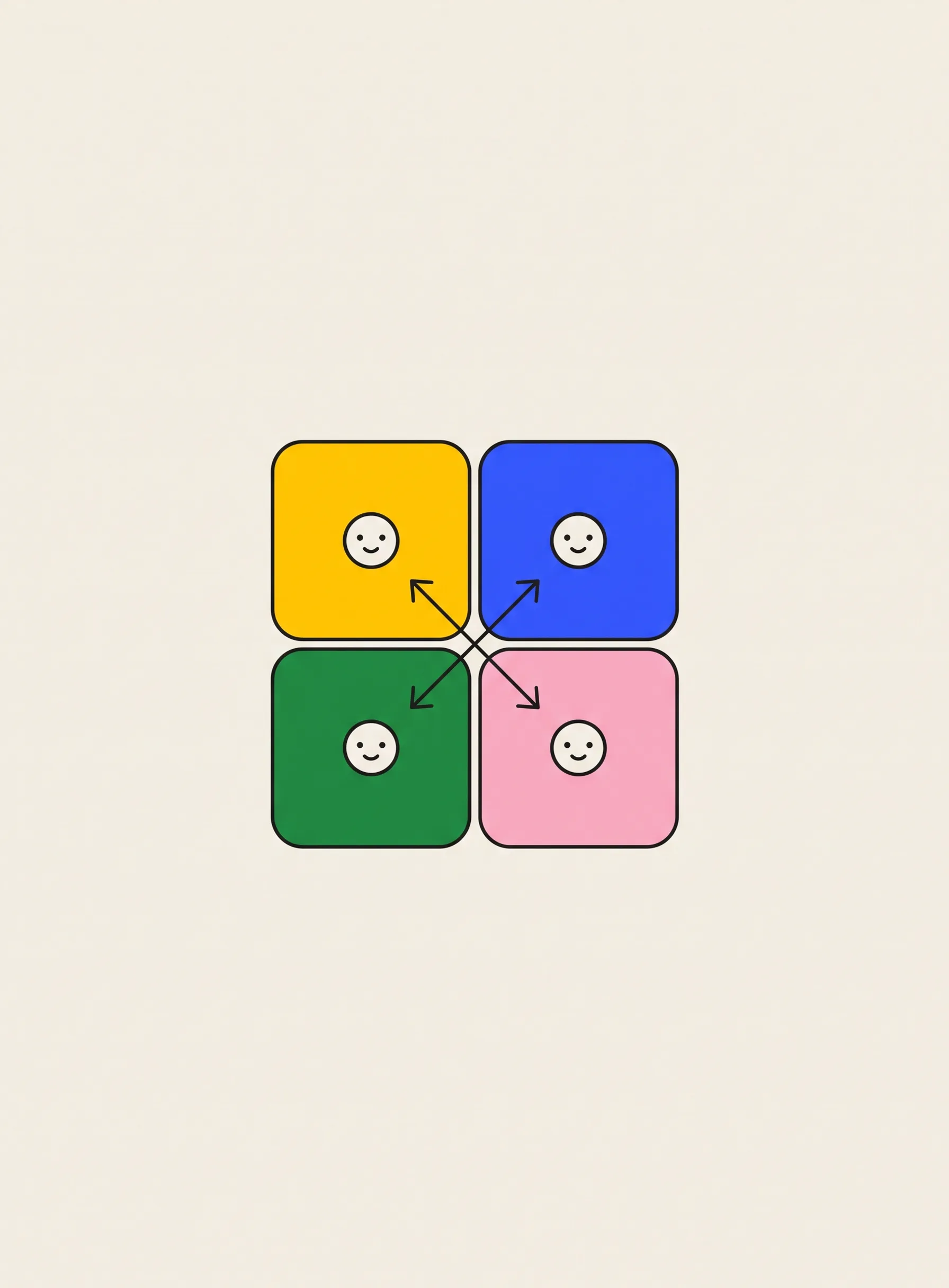
The single most useful thing to memorise about Korean address is a two-by-two grid. Every learner eventually sketches it on the back of something.
Four words, two axes, no exceptions in standard usage. Note what this means in practice: two women and one man in the same room, all three friends, and the man and the woman use different words for the same older person sitting opposite them. Nothing about the older person changed. The word is reporting on the speaker.
Now the half of the system that textbooks skip: there is no matching grid going downward. For anyone younger there is exactly one word, 동생, and it is gender-neutral. You can specify with 남동생 (younger brother) and 여동생 (younger sister), but here is the catch — 동생 is a word you use about someone, not to them. Nobody calls across a room 동생아. You use the person’s name.
That asymmetry tells you what the system is really for. Korean is not marking family relationships. It is marking which direction respect flows. Upward you need a word, because a bare name aimed upward is rude. Downward the name is fine, so no word was ever invented. Once you see that, 언니 stops being vocabulary and starts being grammar.
One more wrinkle: for people of exactly the same age, there is no term at all. Same-year Koreans are 친구 and use each other’s names. This is why the age question arrives so early in a Korean conversation. It is not nosiness. Until age is settled, neither person knows what they are allowed to call the other, and the sentence cannot be finished.
Where 언니 goes once it leaves the family
Ask a Korean woman how many people she calls 언니 and the honest answer lands somewhere around twenty. At most one of them is her sister.
Friends and school. Any woman older than you by a year or more is a candidate. At school and university the boundary is sharp: 언니 for the years above, names for your own year. Among adult friends it softens into a general marker of ‘older, and we are close enough that I can say so’.
At work. Startups, small teams, creative agencies, restaurants and shops — 언니 circulates freely between women. In a conservative office, a bank or a large corporation, it does not: there you use the job title. The tell is whether the workplace runs on titles or on first names. If people are calling each other 대리님 and 과장님, 언니 is out of place.
In shops and restaurants. This one runs both directions and both are worth knowing. A customer calling a female member of staff 언니 is extremely common and quietly contested — plenty of Koreans find it over-familiar, and 저기요 is the neutral, always-safe way to get attention. In older restaurants you will also hear 이모 (‘aunt’) for a middle-aged server, which is warmer and generally better received. Going the other way, a shop owner or hairdresser will call a female customer 언니 regardless of who is actually older, and that version is pure flattery-as-service — roughly the tone of an English shop assistant saying my love.
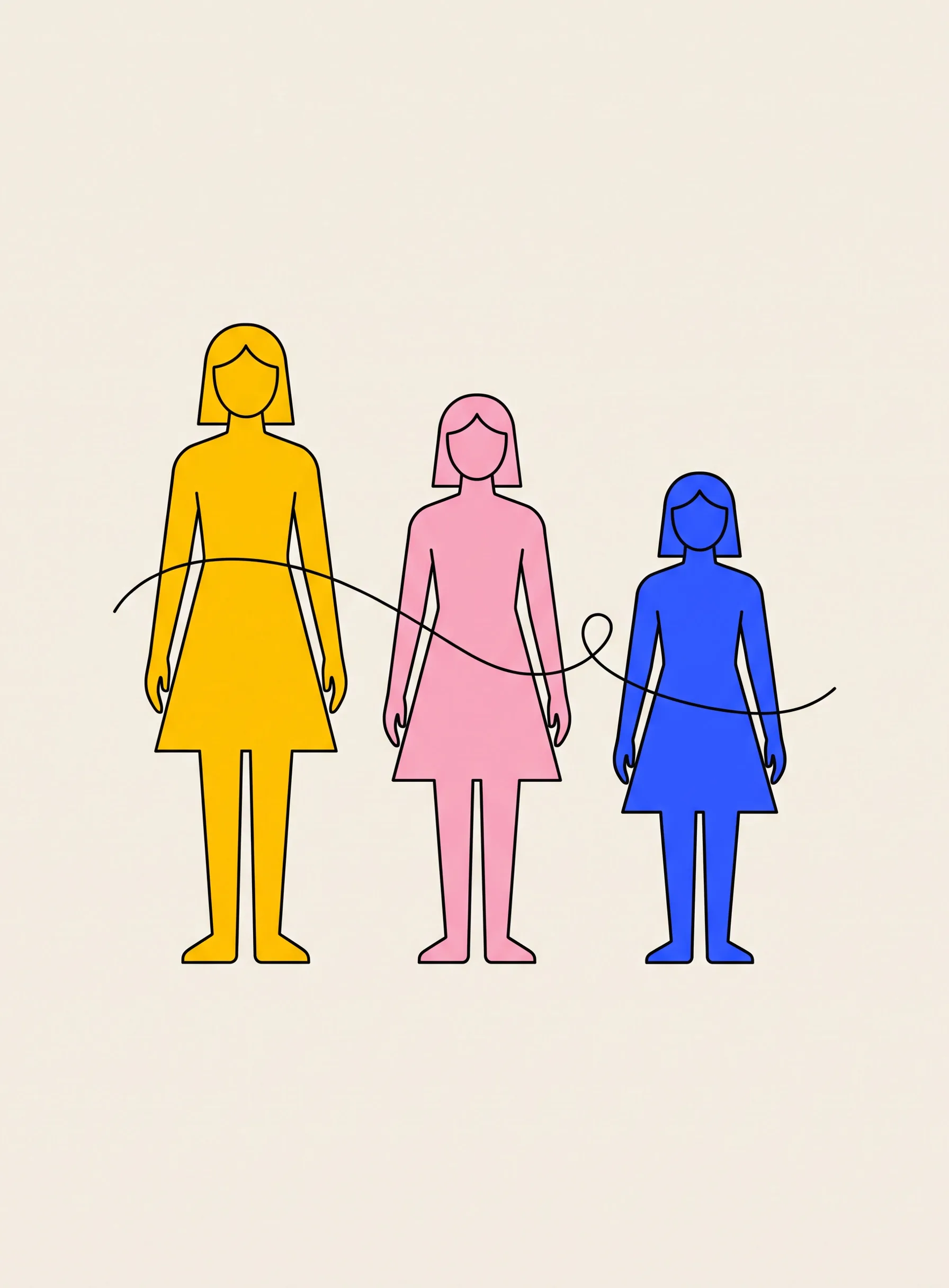
The pattern under all of these is the one that governs Korean pet names too: 언니 claims closeness, upward. Between two women who both accept the closeness, it is warm. Reached for too early, or aimed at someone who has not agreed to be your 언니, it reads as taking a liberty. Hearing that line is the actual skill; the dictionary definition takes ten seconds.
언니 in K-pop and K-dramas
Because so much learner Korean arrives through a screen, it is worth knowing how entertainment has bent the word.
In fandom, 언니 라인 — ‘unnie line’ — is the standard name for the older members of a girl group, and it is one of the few Korean phrases that crossed into English-language fan communities untranslated. Fans also use 언니 for the idols themselves, and the gender rule holds even there: a female fan calls an older idol 언니, a male fan calls her 누나. Two people, same idol, different word, and the difference is entirely about which fan is speaking.
Drama writers use 언니 as a plot signal. The moment a character stops using a name and starts saying 언니 is the moment she has been admitted to the circle — the same kind of beat as a couple switching into 반말. Watch for the reverse too, because it is sharper: 언니 delivered flatly and slowly between two women who dislike each other is not affection at all. It is a needle, and the politeness is exactly what makes it one.
Subtitles flatten all of this. ‘Sis’ loses the gender rule; a substituted name loses the relationship; an omission loses both. Fansubs often leave unnie in English precisely because there is nothing to translate it into. If you are learning from television, the fix is cheap: pick one episode and note every 언니 you hear along with who said it to whom. Twenty examples and the permission structure becomes obvious in a way no explanation achieves.

언니 or 선배 or 씨? Choosing at work
Three words compete for the same slot, and picking the wrong one is the most common way a learner sounds off in a Korean office.
- 언니 — personal. It says we are close, and you are older. Warm, and only appropriate once the relationship has actually warmed.
- 선배 — institutional. It says you joined before me, at the same school or the same company, and says nothing about age or closeness. Crucially it is gender-neutral, which makes it the safest term in a mixed room.
- Name + 씨 — neutral. 지은 씨, 김지은 씨. The default polite address between adults with no established hierarchy. Not cold, just unmarked.
- Title + 님 — 팀장님, 과장님, 선생님. In any workplace that runs on titles, this beats everything above it and you should not go looking for an alternative.
The safe ladder, in order: title, then 씨, then 선배, and only then 언니 — and you arrive at 언니 because she invited you there, not because you decided the friendship had reached that point.
Which brings up the move that dissolves the whole problem. Koreans navigating this exact ambiguity simply ask: 언니라고 불러도 돼요? — ‘may I call you 언니?’ It is polite, completely ordinary, and charming coming from a learner, because it shows you understood that permission was the issue. The answer is almost always yes, and the asking is what makes it land.
Mistakes learners make with 언니
Nearly all of these come from treating 언니 as the English word sister wearing a Korean costume.
- Saying it as a man. The headline error. If you are male, the word you want is 누나, always. There is no context, joking or otherwise, in which a man calling a woman 언니 sounds like anything but a mistake.
- Using it for a younger woman. 언니 runs strictly upward. For someone younger you use her name; 동생 describes her to other people but is not how you address her.
- Using it for someone the same age. Same birth year means 친구 and names. Calling a same-age Korean 언니 gets you a laugh and an instant correction — which, honestly, is a fast way to learn it.
- Translating ‘my sister’ backwards. English collapses both directions into one word. Korean does not: 언니 is only the older one, and only from a woman. Your younger sister is 여동생.
- Dropping into 반말 the moment you start saying 언니. This is the subtle one. 언니 marks someone as older than you, so the natural pairing is 언니 plus the polite 해요 style — 언니, 이거 드셔 보세요. Casual endings arrive later, when she offers them. Treating the kinship term as a licence to be informal gets the logic exactly backwards.
- Calling a server 언니 in a formal restaurant. It passes in a casual place and grates in an expensive one. 저기요 never does.
- Romanisation confusion. Unnie, eonni and onnie are all the same two syllables, 언니. The official spelling is eonni; the internet settled on unnie; both are pointing at a vowel English does not have.
How to actually start using 언니
The definition takes a minute. The timing takes considerably longer, because it is a social judgement rather than a rule, and reading about it does not install the judgement.
- Settle the age first. 나이가 어떻게 되세요? or, more casually, 몇 살이에요? sounds blunt in English and is entirely ordinary in Korean. Note that the kinship terms still run on birth year, not on the international age Korea officially adopted in 2023 — two people born in the same year are 친구 even if their birthdays are eleven months apart.
- Ask for the word rather than assuming it. 언니라고 불러도 돼요? costs nothing and converts a potential misstep into a small moment of warmth.
- Follow, do not lead. Let the Korean speaker set the level of closeness, then match it. This is the reliable strategy for every address term in the language, not only this one.
- Keep the politeness level matched. A new 언니 gets 해요 style. An old 언니 gets 반말, once she has offered it. If you are unsure which you are in, you are in the first one.
- Collect examples deliberately. One drama episode, one notebook line per 언니 you hear, noting speaker and listener. The rules emerge from the data faster than from any article, including this one.
And then use it with a person, because address terms are the hardest part of Korean to learn alone. A textbook will tell you 언니 means ‘older sister’. It will not tell you that you deployed it three weeks early, or that the woman you used it on is four months younger than you. CoffeeTalk pairs you with native Korean speakers for short conversations, and this makes an unusually good thing to bring to one: ask your partner who she calls 언니 and why, and you will get ten minutes of specific, current, completely unteachable detail. Setting your topics to family, work or friendship makes these words surface on their own.
For the neighbouring words, see 오빠, 누나, 형 and 선배, or step back for the whole system in Korean honorifics.

FAQ
What does unnie (언니) mean in Korean?
언니 means 'older sister', but only when a woman is speaking. A female speaker uses it for any older female — a real sister, a school senior, an older friend, a colleague, even a stranger. A man addressing the same person would say 누나 instead.
Can a man say 언니?
No. Korean kinship terms encode the speaker's gender as well as the listener's, so 언니 is exclusively a woman's word. Men use 누나 for an older woman and 형 for an older man. A man saying 언니 is an immediately noticeable error, not a mild informality.
What is the difference between 언니 and 누나?
They point at the same person and differ only in who is speaking. A woman calls an older woman 언니; a man calls her 누나. In a girl group's fandom you will see both used for the same idol, depending on whether the fan is female or male.
Do you only call your actual sister 언니?
Far from it. Most of the people a Korean woman calls 언니 are not related to her. The term extends to older friends, school and workplace seniors, and in casual settings even shop and restaurant staff, though 저기요 is the safer way to get a stranger's attention.
When can I start calling someone 언니?
Once you know she is older and the relationship is friendly enough to say so out loud. The simplest route is to ask — 언니라고 불러도 돼요?, 'may I call you 언니?' — which is a completely normal Korean question and reads as thoughtful rather than awkward.