
Korean culture
Hyung Meaning: What 형 Really Means and Who Gets to Say It
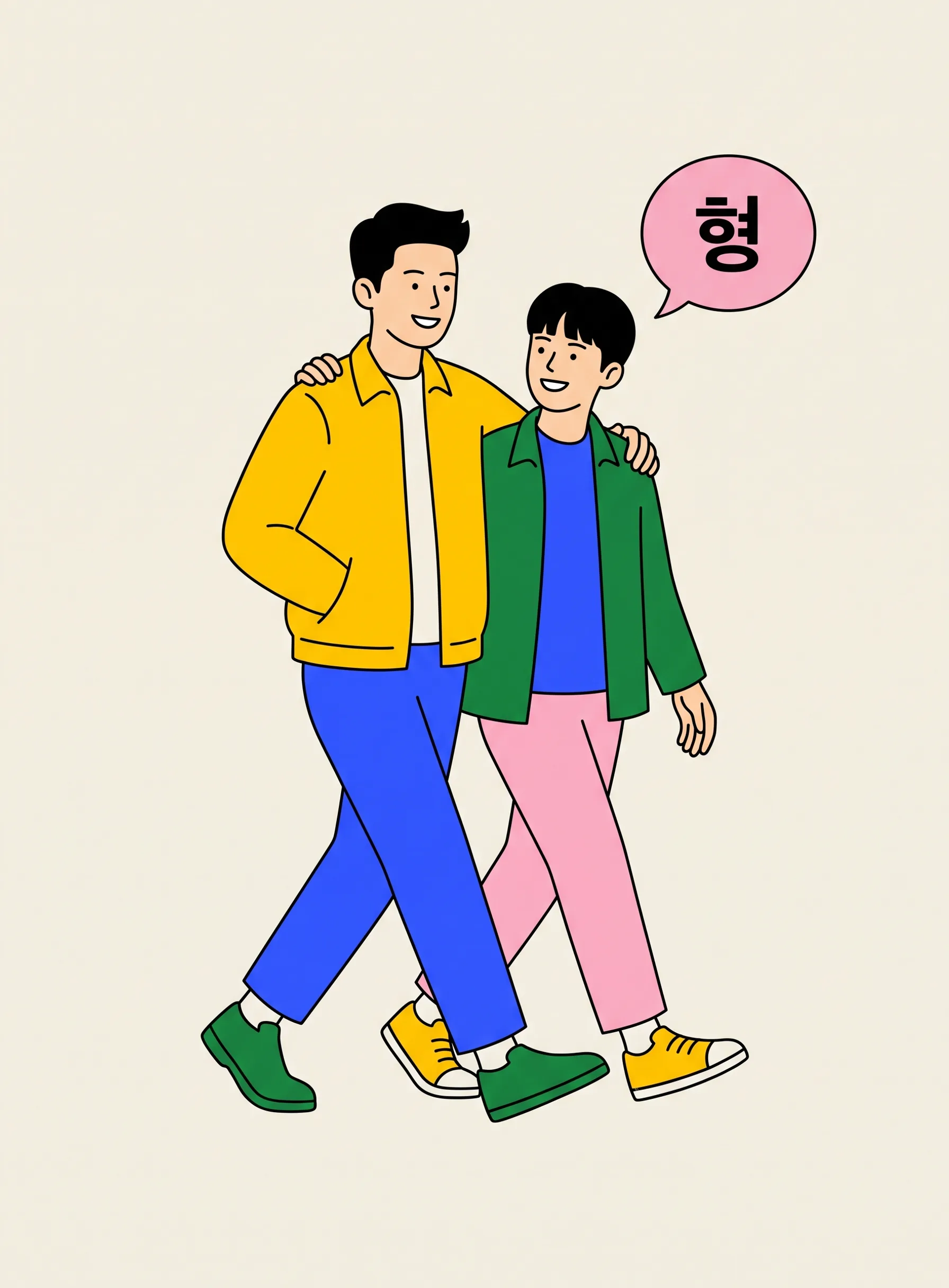
If you have watched more than one K-drama, you have heard it: a younger man calling an older one hyung, sometimes warmly, sometimes through gritted teeth, sometimes right before a fight. The hyung meaning looks simple in a dictionary — ‘older brother’ — but the word does far more work than that translation suggests.
형 (hyung) is one of four Korean sibling words that double as everyday terms of address, and it is the one used by men, to men. Get the rules right and you sound like you understand how Korean relationships work. Get them wrong and you can accidentally call a stranger your brother, or a woman a man. Here is what the word really means, who is allowed to say it, how it differs from oppa, and how it actually sounds in the mouth of a Korean speaker.
The hyung meaning in one sentence
형 (hyung) means ‘older brother’, and it is what a male speaker calls an older male — his actual brother, or an older male friend he is close to. That single sentence contains three rules that Korean speakers apply without thinking:
- The speaker is male. A woman calling an older man 형 sounds wrong; her word is 오빠 (oppa).
- The person addressed is male. An older woman gets 누나 (noona) from a man.
- The person addressed is older — but usually not by a lot. A man ten or fifteen years older stops being a plausible 형 and starts being 아저씨 (ajeossi, roughly ‘sir’) or a job title.
Blood has nothing to do with it. Korean has no separate word for ‘brother by birth’ versus ‘older guy I’m close to’; 형 covers both, and Koreans will add 친형 (chin-hyung, ‘real older brother’) only when they need to make the distinction clear.
Pronunciation trips people up more than meaning. The romanisation hyung suggests a ‘yung’ sound, but the vowel is closer to the ‘u’ in hung said with a very light ‘y’ in front: roughly hyeong, one syllable, with the tongue relaxed. You will also see it romanised hyeong for exactly that reason.
Hyung, oppa, noona, unnie: the four-way grid
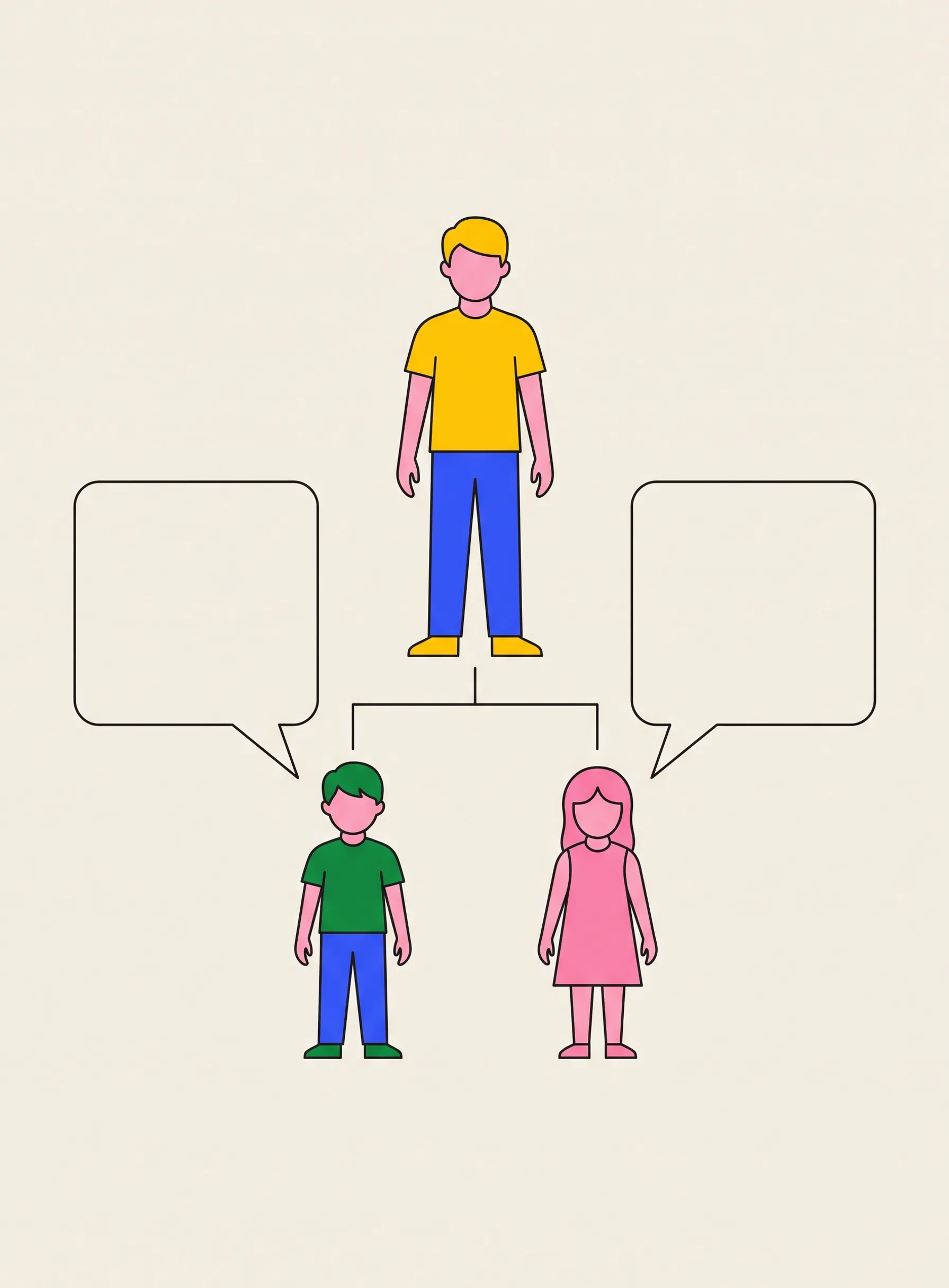
Korean sibling words are a two-by-two grid, and the axes are the gender of the speaker and the gender of the older person. Once you see it laid out, the whole family stops being confusing:
- Man speaking to an older man → 형 (hyung)
- Woman speaking to an older man → 오빠 (oppa)
- Man speaking to an older woman → 누나 (noona)
- Woman speaking to an older woman → 언니 (unnie)
Notice what is missing: there is no special word for a younger sibling that you use to their face. 동생 (dongsaeng) exists, but you use it to talk about a younger person, not to address them. Younger people get called by name, and the age hierarchy is expressed entirely by the fact that they, in return, must use one of the four words above.
This is why the four words carry so much weight. In English, ‘bro’ is decoration; you can drop it and nothing changes. In Korean, choosing 형 instead of someone’s bare name is grammatically expected once you are close and they are older. Leaving it out is not neutral — it reads as either very distant or slightly rude.
The words also affect the rest of the sentence. If you call someone 형, you will normally be speaking to them in polite or at least softened language, while they are free to speak to you casually. The word and the verb endings move together, which is one reason the Korean greetings you pick change depending on who you’re talking to.
How hyung is actually used in a sentence
Korean speakers rarely use 형 on its own for long. It attaches to names, takes suffixes, and appears in fixed phrases. The forms you will meet most:
- Name + 형. 민수 형 (Minsu hyung) — the default way to address or refer to a specific older friend. Note it is the first name, never the surname, that goes in front.
- 형 on its own. Used when talking directly to the person: 형, 밥 먹었어? (‘Hyung, have you eaten?’). Korean drops subjects freely, so 형 often does the job a pronoun would do in English.
- 형님 (hyung-nim). 형 with the honorific suffix 님. This is the formal, respectful version — used for a wife’s older brother, for a senior in a very hierarchical group, and famously in gangster films, where every underling calls the boss 형님.
- 우리 형 (uri hyung). Literally ‘our older brother’, meaning ‘my older brother’. Korean uses uri (our) for family members even when you are an only child speaking alone, and it sounds natural where ‘my’ would sound cold.
- 큰형 / 작은형. ‘Big hyung’ and ‘small hyung’ — the eldest and the second-eldest older brother, when you have more than one.
A few sentences you will hear constantly, worth recognising by ear:
- 형, 이거 뭐예요? — ‘Hyung, what is this?’
- 형이 살게. — ‘Hyung will pay.’ (The older person paying is the norm, not a favour.)
- 형 말 들어. — ‘Listen to your hyung.’ Half affectionate, half an order.
- 형이 미안해. — ‘Hyung is sorry.’ Referring to yourself in the third person as 형 is normal when you are the older one.
That last point surprises learners: Koreans often use 형 about themselves when talking to a younger man. It isn’t grandiose, it is simply the relationship word standing in for ‘I’.
When you can call someone hyung, and when you can't
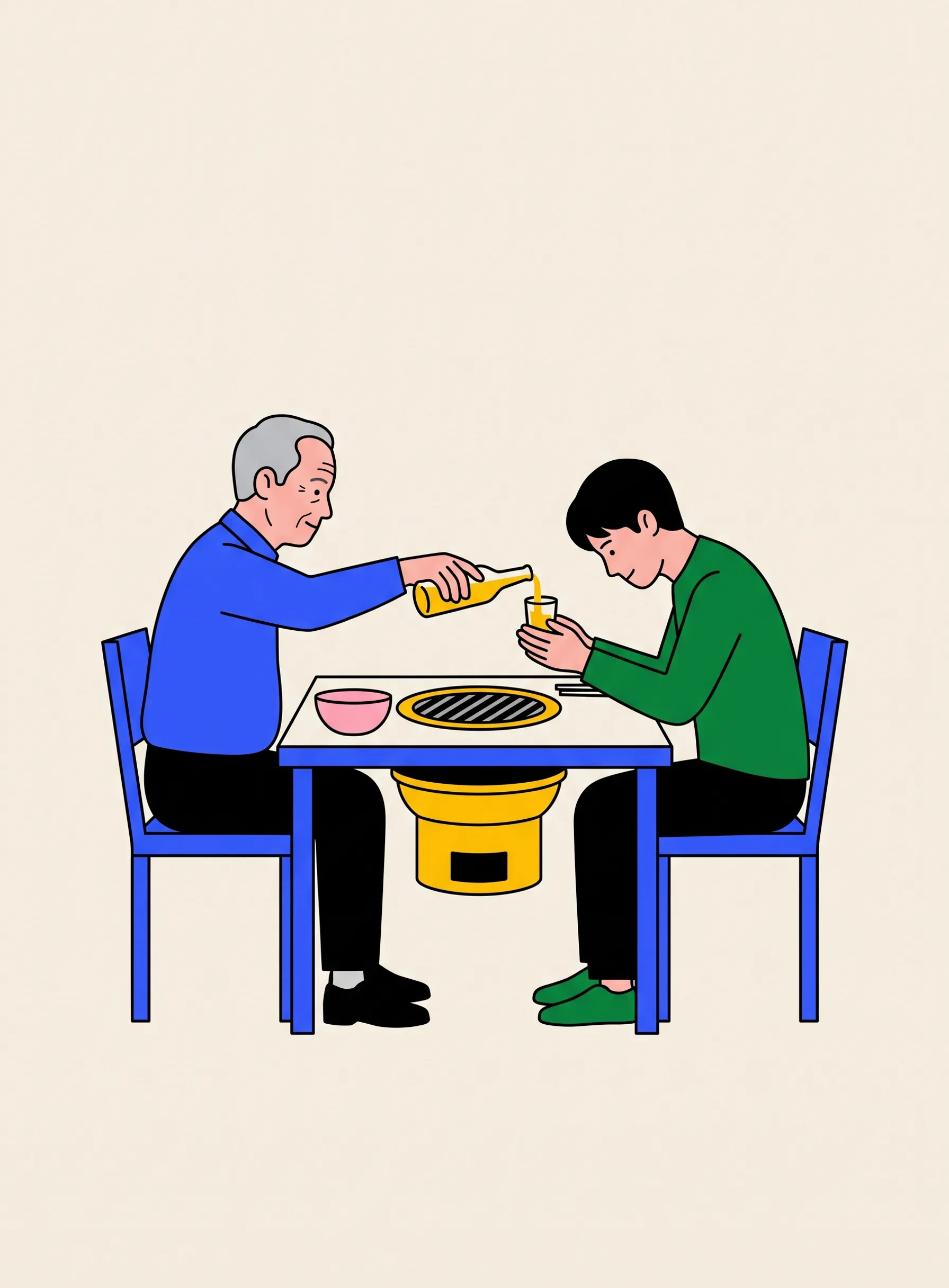
Because 형 states a relationship, using it is a small social event. Koreans do not automatically call every older man 형; there is usually a moment, often explicit, where it becomes allowed.
You need to be close. A colleague who is two years older is not 형 on day one. He is 선배 (sunbae, senior) at school or in a company, or 대리님 / 과장님 (his job title with 님) at work. 형 arrives later, often after a night out, and often after someone actually says 형이라고 불러 (‘call me hyung’). If you are not sure, the safe question is 형이라고 불러도 돼요? — ‘Is it okay if I call you hyung?’ Nobody is offended by being asked.
The age gap needs to be plausible. One to ten years older is 형 territory. Beyond that, the word starts to feel like a joke or a piece of flattery. A man in his fifties talking to a man in his twenties is 아저씨, 선생님 (teacher / sir), or a title, not 형 — unless they are actual brothers.
Work has its own rules. In most Korean offices, calling a senior 형 out loud in a meeting would be a mistake even if you use it privately. Titles rule in formal settings; 형 comes out over dinner. Younger startups and creative industries are looser, but the default is still title first, 형 second.
Same age? No hyung. Korean counts age by birth year, so two people born in the same year are 친구 (chingu, friends and equals) even if one is eleven months older. This is why Koreans ask your age or birth year so quickly after meeting you: they are working out whether 형 is on the table, not being nosy. The Korean age and number systems feed directly into this calculation.
Hyung in K-dramas and K-pop
The reason the word reaches non-Korean speakers at all is entertainment, and entertainment uses it in a few very recognisable ways.
In idol groups, members are sorted into a hyung line and a maknae line — the older members and the younger ones. In BTS, Jin, Suga, J-Hope and RM are the hyung line; Jimin, V and Jungkook are the maknae line. Listen to any group interview and you will hear the younger members say 형 dozens of times, because within a group the age hierarchy is real and the word is mandatory. The maknae, being the youngest, calls literally everyone else 형 or 누나.
In dramas, 형 is the sound of male closeness, and writers use it as a marker. Two characters who start out on surnames and titles will switch to 형 when they become allies. A brother who has been cold for six episodes says 형이 미안해 in episode seven, and the audience knows the arc has turned. In gangster and cop stories, 형님 signals a strict hierarchy: it is what every subordinate calls the boss, with a bow.
In variety shows, 형 becomes comedy. Older hosts demand it; younger guests overdo it; someone who is one year older insists on being called 형 for the whole episode. The joke works because Korean viewers know exactly how much the word is supposed to mean.
One caution for fans: subtitles frequently translate 형 as a name or drop it entirely, because English has no equivalent. If you are learning by watching, keep the Korean audio on and listen for the word itself. It tells you who is older, who is close, and who is being respectful in a way the English line never will. It’s the same reason a phrase like saranghae lands differently once you know who is allowed to say it to whom.

Mistakes non-Koreans make with hyung
The word is short, so the mistakes are all about context. These are the ones Korean speakers notice instantly.
- Women using hyung. This is the big one. Fans pick it up from male idols and use it themselves. From a woman, the word for an older man is 오빠 — always. (There is one narrow exception: some women in very male environments, like sports teams, jokingly adopt 형, but it is a deliberate joke and marked as one.)
- Calling a stranger hyung. A shopkeeper, a waiter, a man on the street: none of them are your 형. Use 저기요 (‘excuse me’) to get attention, or 사장님 (‘boss’) for anyone running a business. 형 assumes a relationship that isn’t there.
- Using it for someone younger or the same age. 형 always points upward in age. Calling a younger man 형 is either a mistake or sarcasm.
- Putting it before the name. It is 민수 형, never 형 민수. The relationship word comes after the name, the same way 님 and 씨 do.
- Overusing 형님. Learners reach for the 님 version to be extra polite and end up sounding like a gangster underling. In ordinary life, 형 is already respectful. Save 형님 for your wife’s older brother and for very formal groups.
- Thinking it translates as ‘bro’. English ‘bro’ is casual, equal, and optional. 형 is affectionate but hierarchical, and once the relationship exists it is not optional. The closest English feeling is probably ‘big brother’ said sincerely, which is a phrase English speakers almost never use.
If you are a man with an older Korean male friend, the fix for all of these is the same: ask once (형이라고 불러도 돼요?), then use it consistently. Consistency is what makes it sound natural; switching between his name and 형 is what sounds off.
How to actually start using hyung
Words of address are impossible to learn from a list, because the whole point of them is the relationship. You can memorise the grid above in five minutes and still freeze when a Korean friend two years older says ‘just call me hyung’. The only way past that is to say it to a real person and notice that the sky doesn’t fall.
Three things that help:
- Learn the grid by pairs, not by single words. 형/누나 belong to a male speaker, 오빠/언니 to a female one. Drill your own pair until it is automatic, and only recognise the other.
- Listen for it in unsubtitled clips. Variety shows are ideal: the hierarchy is stated out loud, constantly, and you can hear who calls whom what and how they change their verb endings to match.
- Ask about age early and treat it as normal. Koreans do. 몇 년생이에요? (‘What year were you born?’) is the question that unlocks which word you will use for the rest of the friendship.
Then use it with someone. A conversation partner who is a little older than you, and Korean, is the fastest way to find out whether 형 or 누나 comes out naturally — and to get corrected gently if you pick the wrong one. CoffeeTalk pairs you with native Korean speakers for short conversations, and the age question will come up in the first two minutes whether you plan it or not. Choosing topics around family and friends makes the sibling words come up even faster.
If you are collecting the rest of the family, oppa and maknae are the other two words every K-drama viewer needs, and the ways to say thank you in Korean follow exactly the same politeness logic that decides between 형 and 형님.

FAQ
What does hyung mean in Korean?
형 (hyung) means older brother. It is used by a male speaker to address or refer to an older male — a real brother or a close older male friend. Women use a different word, 오빠 (oppa), for the same relationship.
Can a girl call someone hyung?
Not normally. 형 is reserved for male speakers. A woman calls an older man 오빠 (oppa) and an older woman 언니 (unnie). A woman using 형 is heard as a mistake or a deliberate joke.
What is the difference between hyung and oppa?
Both mean older brother, and both are used for real brothers and close older male friends. The difference is the speaker: men say 형 (hyung), women say 오빠 (oppa). The older man being addressed is the same in both cases.
What does hyung-nim mean?
형님 (hyung-nim) is 형 with the honorific suffix 님. It is a formal, respectful version used for a wife’s older brother, for seniors in very hierarchical groups, and in films for gang bosses. In everyday friendships plain 형 is already polite enough.
Do you say hyung before or after the name?
After. It is 민수 형 (Minsu hyung), using the first name, never 형 민수 and never the surname. When speaking directly to the person, Koreans often just say 형 on its own, since Korean drops subjects and pronouns freely.